 0
 0
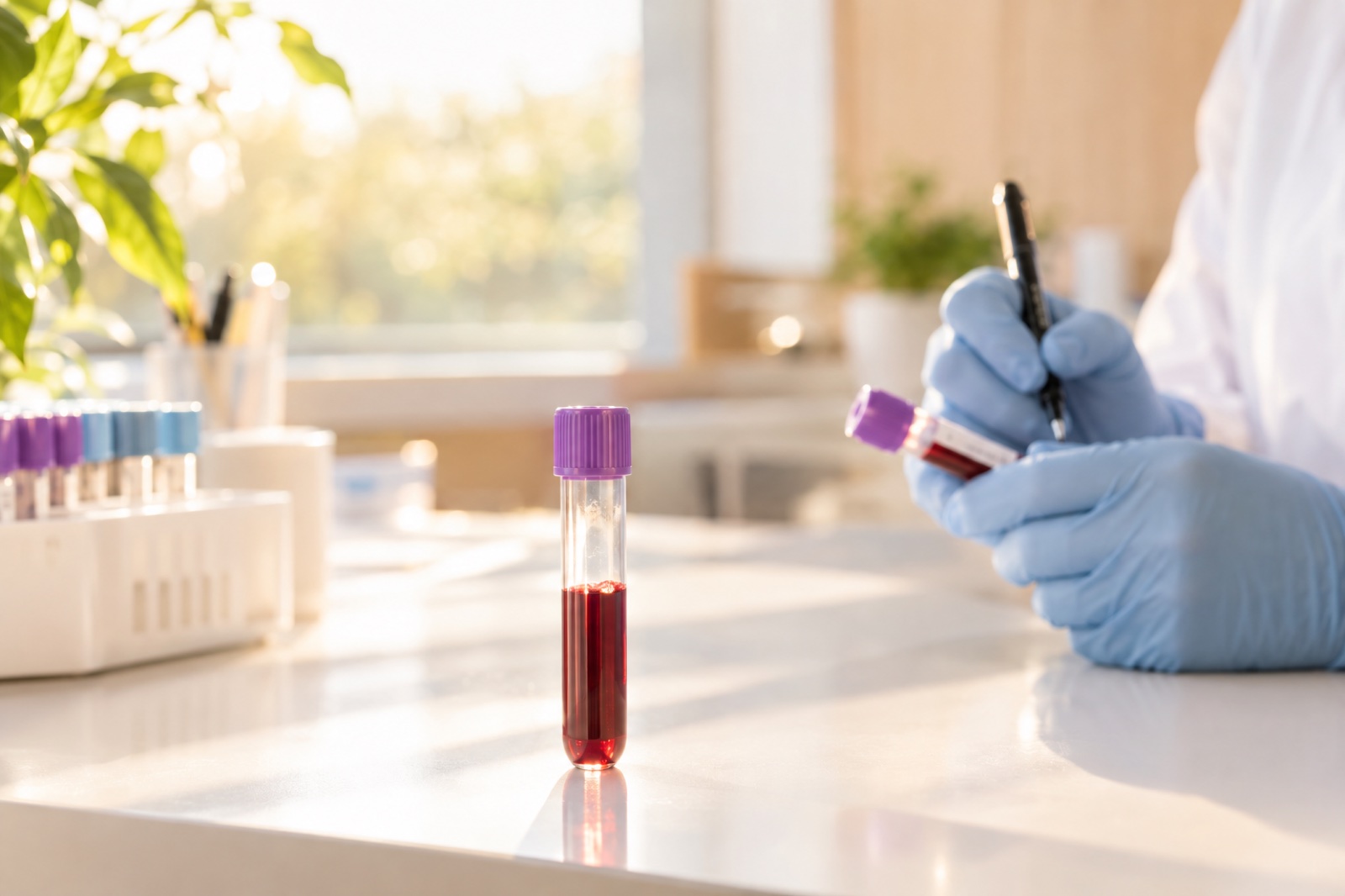
A nurse takes a small vial of blood from your arm. Nothing about it feels unusual. A few weeks later, someone hands you a sheet of paper with a number on it, and that number is an estimate of how likely you are to start losing your memory in the next ten years.
That test is real. Not a promise about tests that might arrive one day. An actual measurement, taken from ordinary blood, published this year in one of the largest medical journals in the world.
Which leaves a question nobody can answer on your behalf. If the test were free and sitting in your local clinic tomorrow morning, would you want the number?
What the Alzheimer’s Blood Test Actually Measures
The test looks for a protein fragment in the blood called p-tau217. It is a modified form of tau, one of the two proteins that build up in the brain in Alzheimer’s disease, and it tracks closely with the other one, beta amyloid.
Until recently, finding out whether those proteins were accumulating meant a brain scan or a spinal tap. Expensive, uncomfortable, and out of reach for most of the world. A blood draw is none of those things. That is the whole reason this matters.
The study behind the headlines was led by Rachel F. Buckley and Reisa Sperling at the Mass General Brigham Neuroscience Institute, presented at the Alzheimer’s Association International Conference in July and published in JAMA. It pooled 2,684 older adults who had no cognitive impairment at the start, drawn from six separate research groups and clinical trials across North America, Japan and Australia. The average age was around 70. People were followed for roughly five years on average, some for more than a decade. About 478 of them went on to develop cognitive impairment.
The Numbers, and the Caveats the Researchers Put on Them
Here is what the team found, in their own framing.
People whose p-tau217 was very high, meaning more than twice the study average, had an estimated 38 percent chance of developing cognitive impairment within five years, and about 78 percent within ten.
People whose level was only moderately elevated, just above average, had an estimated 15 percent chance within five years, and 45 percent within ten.
Those are big numbers, and they are easy to read as a verdict. The researchers were careful to say they are not. Their own stated caveats are the most useful part of the whole study:
- p-tau217 alone cannot fully predict any individual person’s future risk.
- Age, genetics, kidney function, body weight, and racial and ethnic background all influence the level in your blood, separately from what is happening in your brain.
- The ten-year estimate rests on substantially less data than the five-year one, because fewer people have been followed that long.
- More diverse study populations and longer follow-up are needed before these numbers can be refined.
That third point deserves a pause. The scariest figure in the coverage, 78 percent, is also the least well supported one in the paper.
And that second point matters more than it sounds. If your kidneys are not filtering well, your p-tau217 can read high for reasons that have nothing to do with your memory. The number on the page is not a photograph of your brain. It is a signal with weather in it.
There is one more gap worth naming plainly, because it is rarely mentioned. The six groups of participants came from North America, Japan and Australia. Nobody in this study was recruited in Africa, in South Asia, in Latin America or in most of Europe. The researchers themselves flagged the need for more diverse populations. If you are reading this in Nairobi, Manila or Lagos, the honest answer is that nobody yet knows exactly how these thresholds translate to you.
What Actually Happens to People Who Get Told
This is the part most coverage skips, and it is the part the question actually turns on. We are not guessing here. Researchers have been telling people their Alzheimer’s risk for over twenty years and watching what it does to them.
The main body of work is called the REVEAL study, which disclosed APOE genetic risk results to adults who had a parent with Alzheimer’s. The first trial, published in the New England Journal of Medicine, followed 162 people who had no symptoms. Half learned their result, half did not. Those who learned it did not show more anxiety, more depression or more test-related distress than those who did not. Among people who learned they did not carry the higher-risk version, distress actually went down.
Which looks, at first glance, like permission to find out. But the detail underneath it is where the real finding is.
Everyone in that trial received genetic counselling first. They were prepared. They were walked through what the result would and would not mean before anyone showed it to them. People already in significant emotional distress were more likely to struggle afterwards, and people with diagnosed depression or anxiety were excluded from the trial entirely.
Then compare that with what happens when the preparation is missing. In 2018, Doris Zallen at Virginia Tech published 26 in-depth interviews with people who had learned they were at higher genetic risk, some of whom had sought the test and some of whom stumbled into the result from a test taken for something else. Adverse psychological reactions were reported by a substantial fraction of them, across every group. Those who had gone looking for it. Those who were blindsided. Those with family history and those with none.
The Finding Almost Nobody Quotes
But Zallen’s interviews did not end there, and the second half of that result is the thing worth carrying away from all of this.
Nearly everyone she interviewed said that, in the long run, they had benefited. Not from the number. From the changes they made after it, mostly lifestyle changes they went and found out about on their own. And she reported no cases of families falling apart over it, which is the fear people usually name first.
Her conclusion was that people should be prepared before any such test, allowed to opt out of particular results, and, if a higher risk is revealed, actively helped to decide what to do next.
Read those two studies next to each other and the picture reorganises itself. The damage does not come from knowing. It comes from knowing alone, with no preparation and nothing to do. Give someone the same number with somebody beside them and a path forward, and it stops being a sentence and becomes information.
Which is a strange relief, because the path forward exists whether you take the test or not. The 2024 Lancet Commission on dementia identified fourteen modifiable risk factors, including hearing loss, high LDL cholesterol, depression, head injury, physical inactivity, diabetes, smoking, high blood pressure, excess weight, heavy drinking and untreated vision loss. Their headline estimate is that around 45 percent of dementia cases worldwide could in principle be prevented or delayed by addressing all fourteen. That figure assumes those factors are genuinely causal and could be eliminated completely, which is a very large assumption and the commission says so. But even a fraction of it is not nothing.
What You Can Do Without Ever Taking the Test
None of this requires money, insurance, or a specialist. Most of it is free.
- Walk, most days. Physical inactivity is on the list. A brisk half hour costs nothing and you do not need a gym for it.
- Protect your hearing, and get it checked if people seem to mumble. Untreated hearing loss is one of the larger single contributors on the list, and it is one of the most fixable.
- Stay in company. Isolation is a risk factor in its own right. A weekly conversation that is not transactional counts.
- Keep learning something. Not formal study. Any genuine mental demand: a language, an instrument, a craft, a text you have to work at.
- Treat depression as a health problem, not a character problem. It sits on the same list as blood pressure.
- Wear the helmet. Head injury is on the list, and it is one of the few entries you can take to zero today.
- If you have access to a clinic, get blood pressure, cholesterol and blood sugar checked. Those three are the cheapest high-value measurements in medicine, and unlike p-tau217 you can actually do something about each result.
Notice what is missing from that list. The blood test. Everything above is available to you right now at the same strength whether or not you ever learn your number.
Why the Question Feels Heavier Than It Is
There is something very old about this problem. For almost all of human history nobody could measure a single thing about their own future, and people spent their lives straining to see around the corner anyway. The oldest writing we have is full of it: people asking for a glimpse of what is coming, and being answered, gently and repeatedly, that the day in front of them is the one they were actually given to carry.
What is interesting is that the answer was never “stop thinking about tomorrow.” It was closer to a division of the work. The shape of a whole life is already known and already held by God, and the part that belongs to you is today. That is not a sedative. It is a job description with a manageable scope.
A blood test does not change that division. It just moves a line on a chart you were never the one holding.
So, Would You Want to Know?
If the test arrived at your clinic tomorrow you would still have to decide, and no researcher, doctor or article gets to decide for you.
But it helps to be clear about what you are deciding. You are not choosing whether to find out if you will get Alzheimer’s disease. The test cannot tell you that, and the people who built it say so first. You are choosing whether you want an estimate, with real uncertainty inside it, about a risk you could already start lowering this evening without knowing the number at all.
Put that way, the question tends to get smaller. The walk you would take if the number came back bad is the same walk that is good for you anyway.
You might as well take it tonight.
If you have been circling something similar, a worry that keeps rearranging itself without ever resolving, our How Anxious Am I? assessment is a free, five-minute way to see what shape yours is actually in. And if the idea of a blood sample seeing something years early is new to you, it is becoming less unusual than you would think: researchers recently found signs of inflammatory bowel disease in frozen blood samples a full decade before diagnosis. There is also a pattern here that shows up far outside medicine, which is that the fear of a thing starts acting on us long before the thing does, something researchers found happening to workers who were afraid AI would take their jobs.
A Question Worth Sitting With
If a free, accurate test could tell you today the decade in which your health will turn, would you take it, or would you leave the envelope closed? There is no right answer here, and the reasons people give on both sides are usually better than you expect. Tell us which side you land on in the comments.
Worth Sharing
- There is now a blood test that estimates your Alzheimer’s risk ten years out. The researchers’ own caveats are the most interesting part of it. Would you want the number? https://bgodinspired.com/index.php/health-and-wellness/alzheimers-blood-test-would-you-want-to-know/
- Twenty years of research on telling people their Alzheimer’s risk found something I did not expect: the harm is not in knowing. It is in knowing alone, with nothing to do about it. https://bgodinspired.com/index.php/health-and-wellness/alzheimers-blood-test-would-you-want-to-know/
- Read this if you have ever wondered whether you would want to know what is coming. The honest version of the Alzheimer’s blood test story, caveats included, plus the seven things you can do about your risk tonight without ever taking it. https://bgodinspired.com/index.php/health-and-wellness/alzheimers-blood-test-would-you-want-to-know/
Questions People Are Asking
Can a blood test really predict Alzheimer’s disease?
Not predict, estimate. A blood test measuring a protein fragment called p-tau217 can estimate a person’s statistical risk of developing cognitive impairment over the following five to ten years. In a 2026 study of 2,684 cognitively healthy older adults published in JAMA, people with very high p-tau217 had an estimated 38 percent chance of cognitive impairment within five years and 78 percent within ten. The researchers state plainly that p-tau217 alone cannot fully predict any individual’s future, and that the ten-year figure rests on substantially less data than the five-year one.
What is p-tau217?
p-tau217 is a phosphorylated form of the tau protein, one of the two proteins that accumulate in the brain in Alzheimer’s disease. It is strongly associated with the build-up of the other one, beta amyloid. Its significance is practical: it can be measured in ordinary blood, where previously detecting these proteins required a brain scan or a spinal tap. Levels are also affected by age, genetics, kidney function, body weight, and racial and ethnic background, so a raised result is not by itself a picture of the brain.
Does learning your Alzheimer’s risk cause depression or anxiety?
The evidence says it depends almost entirely on preparation. In the REVEAL trial published in the New England Journal of Medicine, 162 adults with no symptoms were randomly assigned to learn or not learn their APOE genetic risk, and those who learned it showed no more anxiety, depression or distress than those who did not. Everyone in that trial received genetic counselling beforehand, and people with diagnosed depression or anxiety were excluded. A separate 2018 study of 26 people who received results without preparation found adverse psychological reactions were common, though nearly all of them reported long-term benefit from the lifestyle changes they made afterwards.
Should I get an Alzheimer’s blood test?
The researchers behind the 2026 JAMA study did not recommend routine screening of the general public. They suggested the test’s first real use is identifying suitable participants for clinical trials of prevention treatments, and that it may guide monitoring and treatment decisions later, once treatments for early-stage disease are approved. The consistent finding across two decades of disclosure research is that if such a test is taken, the person should be prepared in advance, allowed to decline particular results, and actively helped to decide what to do with the answer.
Can you lower your risk of dementia?
Partly, and the actions do not require a test first. The 2024 Lancet Commission on dementia identified fourteen modifiable risk factors, among them hearing loss, high LDL cholesterol, depression, head injury, physical inactivity, diabetes, smoking, high blood pressure, excess weight, heavy drinking and untreated vision loss. Its headline estimate is that roughly 45 percent of dementia cases worldwide could in principle be prevented or delayed by addressing all fourteen, an estimate that assumes those factors are causal and could be fully eliminated. Several of the actions, such as walking regularly, staying socially connected, protecting your head and continuing to learn, cost nothing.