 0
 0
Greek Word for Thanksgiving: What Does ‘Eucharistia’ Really Mean?
Quick answer: The Greek word for thanksgiving is eucharistia (εὐχαριστία, pronounced yoo-khah-ris-TEE-ah, Strong’s G2169). It means gratitude or the giving of thanks, and it is built from two older Greek ideas: eu (“good, well”) and charis (“grace, gift”). It is also the word behind “Eucharist,” the name many churches give the Lord’s Supper.
Word Study: Where It Comes From
Most of us treat thanksgiving as a feeling, or a holiday. The Greek word treats it as a response to a gift.
Eucharistia grows out of charis, the word for grace: a gift given freely, with nothing earned. From charis Greek formed the verb charizomai, “to give graciously.” Add the prefix eu, meaning “good” or “well,” and you get eucharistos, “well-graced,” or thankful. The verb eucharisteo (“to give thanks”) and the noun eucharistia followed.
So at its root, thanksgiving is “grace answered well.” Where there is a gift, eucharistia is the right response to it. That is why the word so naturally sits next to prayer in the New Testament: gratitude is what grace sounds like when it is spoken back.
A simple, powerful guide to help you experience God in ordinary moments, even when life feels chaotic. Learn the 3-step rhythm that transforms your daily routine into a divine connection.
Where This Word Appears in the Bible
| Reference | KJV Text |
|---|---|
| Philippians 4:6 | “Be careful for nothing; but in every thing by prayer and supplication with thanksgiving let your requests be made known unto God.” |
| Colossians 4:2 | “Continue in prayer, and watch in the same with thanksgiving;” |
| 1 Timothy 4:4 | “For every creature of God is good, and nothing to be refused, if it be received with thanksgiving:” |
| Revelation 7:12 | “Saying, Amen: Blessing, and glory, and wisdom, and thanksgiving, and honour, and power, and might, be unto our God for ever and ever. Amen.” |
A related note: the well-known command in 1 Thessalonians 5:18, “In every thing give thanks: for this is the will of God in Christ Jesus concerning you,” uses the verb form, eucharisteite, from the same family of words.
Verse Deep Dive: Philippians 4:6-7
“Be careful for nothing; but in every thing by prayer and supplication with thanksgiving let your requests be made known unto God. And the peace of God, which passeth all understanding, shall keep your hearts and minds through Christ Jesus.”
Paul is writing to people with real reasons to worry, and he does not tell them to feel better. He gives them a way to pray. Notice what the sentence holds together: “prayer and supplication” (asking, even pleading) with thanksgiving. The word is eucharistia, and it travels alongside the request rather than replacing it.
That detail matters. Paul does not say, “Give thanks instead of asking.” He says to bring the request wrapped in gratitude. Asking alone can leave attention fixed on what is missing. Thanksgiving widens the view to what has already been given, and it is exactly that grace-answered-well posture the word was built for. The promised result is not an answer to the request but peace that “passeth all understanding” standing guard over the heart and mind.
Not All “Thanksgiving” Is the Same
Greek has a few neighboring words worth telling apart:
- Eucharistia (εὐχαριστία): thanks, gratitude, the response to a gift.
- Charis (χάρις): grace itself, the gift. In a few verses it is even translated “thanks,” as in 1 Timothy 1:12, where the KJV has “I thank Christ Jesus,” literally “I have grace [charis] to Christ Jesus.”
- Eulogia (εὐλογία): blessing, “good word.” It speaks well of someone, where eucharistia thanks someone for something.
The family resemblance is no accident: the thanks (eucharistia) and the grace (charis) are two ends of the same exchange.
Why the Original Word Changes the Meaning
In English, “thanksgiving” can sound like a mood you either have or you don’t. In Greek, eucharistia has grace built into its very spelling. You cannot say it without pointing to a gift. That changes how it reads in the Bible: thanksgiving is not a performance of cheerfulness, it is an honest acknowledgment that what you hold was given.
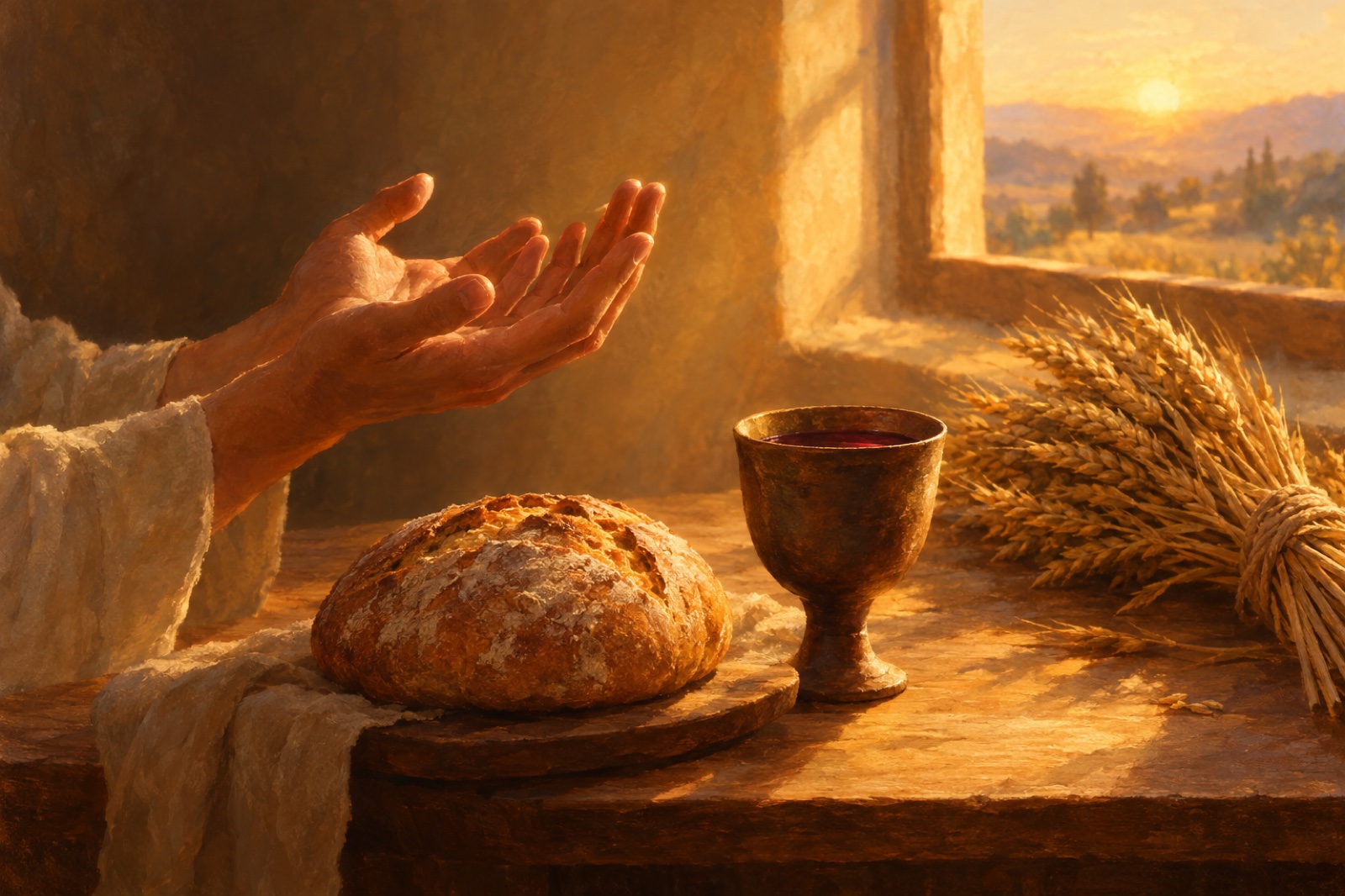
It also explains why the early church named its shared meal after the word. When Jesus “gave thanks” over the bread (the verb eucharisteo), the table became a lasting picture of receiving grace and answering it with gratitude. “Eucharist” simply means “thanksgiving.”
Living It Out
Try pairing every request this week with one thing already given. Before you ask for anything in prayer, name one gift first, and notice what happens to the size of the worry.
Journal Prompts
- Philippians 4:6 puts thanksgiving with the request. What are you currently asking for, and what has already been given in that same area of your life?
- Eucharistia is built from “good” and “grace.” Whose kindness to you have you received without ever really thanking them?
- 1 Timothy 4:4 says everything is to be received with thanksgiving. What ordinary thing in your day do you usually take for granted?
Prayer
Lord, you give so freely, and I so often notice only what is missing. Teach me eucharistia: to answer your grace well. As I bring my requests to you today, let thanks go with them, and let your peace stand guard over my heart and mind. Amen.
Share This
- The Greek word for thanksgiving, eucharistia, is built from “good” + “grace.” Gratitude is grace answered well. [Post URL]
- Did you know “Eucharist” literally means “thanksgiving”? The Greek word eucharistia is what Paul says belongs in every prayer. [Post URL]
FAQ
What is the Greek word for thanksgiving?
The noun is eucharistia (εὐχαριστία, Strong’s G2169). The matching verb, “to give thanks,” is eucharisteo.
Is “Eucharist” the same word as thanksgiving?
Yes. “Eucharist” comes straight from eucharistia and simply means “thanksgiving.” Many churches use it as a name for the Lord’s Supper because Jesus gave thanks over the bread and cup.
How is eucharistia related to grace?
It is built from eu (“good”) and charis (“grace”). The giving of thanks is the response to the giving of grace.
Does the Bible say to give thanks only when things go well?
No. Philippians 4:6 places thanksgiving alongside supplication, which means asking in difficulty, and 1 Thessalonians 5:18 says “in every thing give thanks,” not “for every thing.”
A simple, powerful guide to help you experience God in ordinary moments, even when life feels chaotic. Learn the 3-step rhythm that transforms your daily routine into a divine connection.