 0
 0
You have seen this verse. On a mug, on a wall print, at the bottom of someone’s email. Seek ye first the kingdom of God… and all these things shall be added unto you. Somewhere along the way it stopped being a sentence and became a formula: put God first, and the rest arrives.
So you tried it. You prayed earlier. You gave when it was tight. You kept showing up. And the rent is still due, the results still have not come back, the job still has not called. Which leaves a question most of us never say out loud: did I not seek hard enough? Or did the verse never mean what I was told it meant?
Here is the part almost nobody mentions. Matthew 6:33 is not a standalone line. It is the last sentence of a paragraph — and inside that paragraph, Jesus says out loud exactly what “all these things” are. Not once. Twice, in the two verses directly before it.
The Matthew 6:33 Meaning Starts Two Verses Earlier
Read verse 31 first. Jesus is not being vague:
“Therefore take no thought, saying, What shall we eat? or, What shall we drink? or, Wherewithal shall we be clothed?”
Matthew 6:31, KJV
Three things. Food. Drink. Clothing. Then verse 32 repeats the phrase that verse 33 is about to use again:
“(For after all these things do the Gentiles seek:) for your heavenly Father knoweth that ye have need of all these things.”
Matthew 6:32, KJV
And only then comes the famous line:
“But seek ye first the kingdom of God, and his righteousness; and all these things shall be added unto you.”
Matthew 6:33, KJV
Three sentences in a row, one phrase running through all three. “All these things” in verse 33 is not a blank space for you to fill in. It is pointing backwards at a list Jesus already gave you.
The Grammar Says “Backwards,” Not “Anything”
In the Greek, “these things” is tauta — a demonstrative pronoun. A demonstrative is the word-equivalent of pointing with your finger. It cannot stand on its own. It always has to be pointing at something, and what it points at is whatever was just named.
Jesus did the naming in verse 31. Food, drink, clothing. So when verse 33 promises that “all these things shall be added,” the promise has edges, and Jesus drew them himself, two sentences earlier.
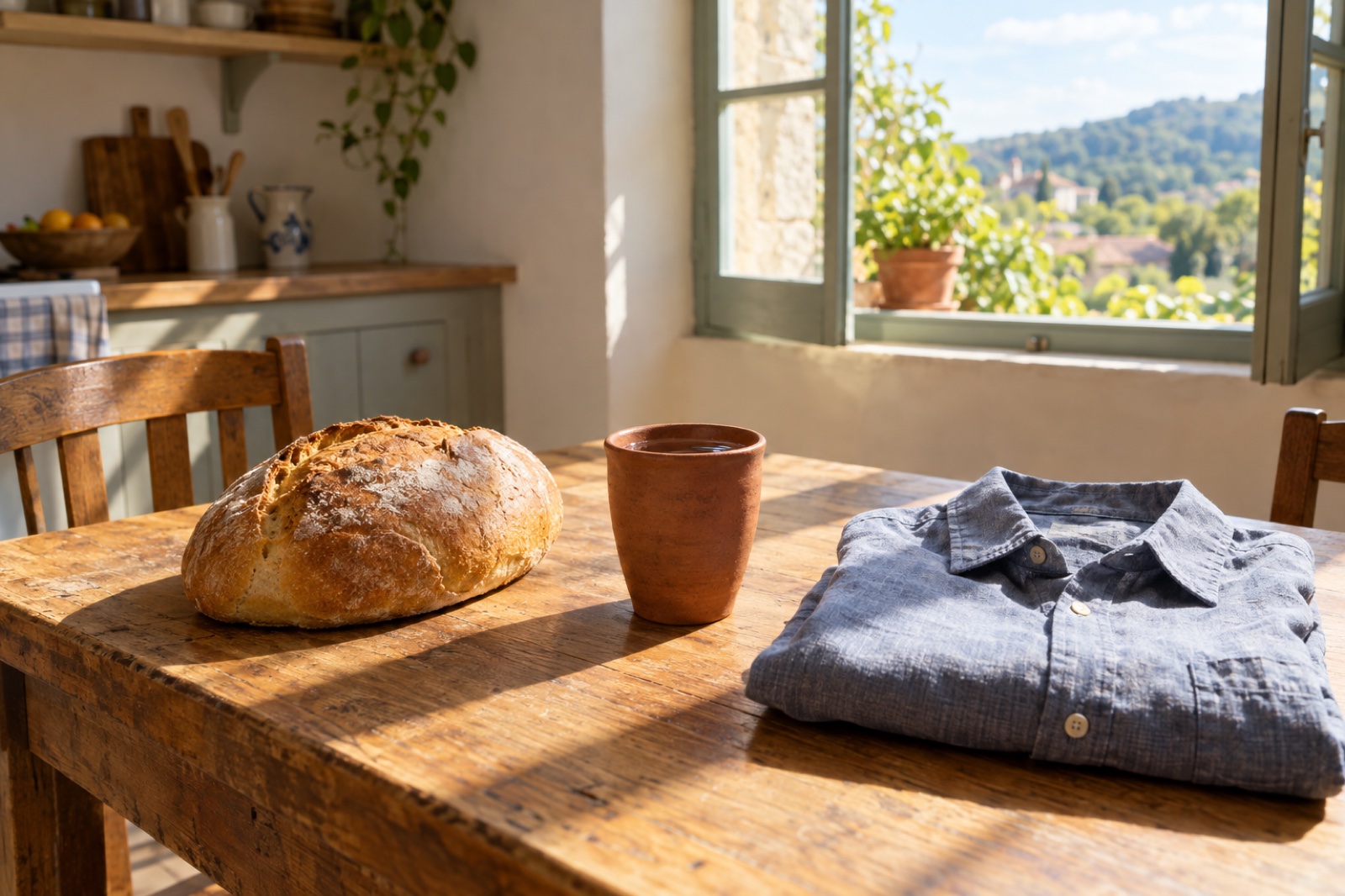
That is a smaller promise than the mug version. It is also a far more honest one — and, if you sit with it, a much warmer one. The mug version quietly makes your life a transaction. This version says: the basics are covered, so stop carrying them.
“Take No Thought” Was Never About Planning
There is a second thing the old English hides. Three times in this passage the King James Version says “take no thought” — verses 25, 31 and 34 — and the same idea surfaces twice more, as “taking thought” in verse 27 and “take ye thought” in verse 28. Read with modern ears, that sounds like a ban on thinking ahead. Do not budget. Do not plan. Just trust.
The Greek word underneath it is merimnaó. Lexicons define it as to be anxious, to worry, and it comes from merimna — worries. It is not the word for thinking. It is the word for the churn.
So Jesus is not telling the person lying awake at 3am to stop planning their week. He is telling them to stop being pulled apart by it. The verse is aimed at the gnawing, not at the calendar. If you have ever felt that difference in your own chest, you already know it is real. (The same teaching turns up again in Luke’s Gospel, which we walked through in Feeling Overwhelmed? Luke 12:22 Shows You a Simple Way to Worry Less.)
“Seek” Is Not a One-Time Thing Either
One more detail worth having. “Seek” in verse 33 is zēteite, and it sits in the present imperative — the tense of ongoing action. Not seek once. Closer to keep seeking.
That matters, because a formula is something you complete. You do the input, you collect the output, you are done. A present imperative does not work like that. It describes a direction you keep walking in, on the days it feels like something and the days it feels like nothing.
And what are you walking toward? “The kingdom of God” — basileia in the Greek, which is less a place than a reign, a way things are run. We dug into that word on its own in Greek Word for Kingdom: What Does “Basileia” Really Mean?.
The Turn: It Is a Promise of Enough, Not of More
Put the pieces side by side and the verse flips.
It gets quoted as a lever for getting more. Read in its own paragraph, it is a release from needing more. The things being promised are bread, water and something to wear. The thing being removed is the anxiety wrapped around them. And verse 32 gives the reason, which is not your performance at all: your heavenly Father knoweth that ye have need of all these things.
It is not a formula that pays out. It is an order that sets you down.
That is why the images around this passage are birds and grass, not barns and treasure. Nothing here says seeking God makes you wealthy. Teaching this verse as a wealth formula does not just overstate it — it reverses it, because the whole paragraph is Jesus prying your fingers off the very things the formula promises to deliver. (If money is the pressure you are under right now, What Does the Bible Say About Saving Money? sits on the same ground.)
The relief in Matthew 6:33 is not that you will get everything. It is that the floor is held, so your attention is free to go somewhere better.
Actions to Take
- Read the whole paragraph, once. Matthew 6:25–34, start to finish, in one sitting. It takes about two minutes. Count how many times the words eat, drink and clothing appear. That count is the argument.
- Name the thing you are actually carrying. Write it down in one line. Then ask a plain question of it: is this food, drink or clothing — or is it a step past them? Not to judge the worry. Just to see which promise you are standing on.
- Do one ordinary task undivided. The next meal, the washing, the walk to work. Do that one thing without rehearsing tomorrow while your hands are busy. That is “take no thought” in practice, and it fits in the next ten minutes.
Journaling Prompts
- Which version of this verse have I actually been living on — the formula, or the paragraph? What did I expect to be “added”?
- When the basics have been met in my life, where did my attention go next? What does that tell me about what I am really seeking first?
A Prayer
God, I have been using this verse as a deal, and I think I knew it. I have been waiting for something to be added, and quietly keeping score. Thank you that you already know what I need, before I have worked out how to ask for it. Help me put down the churn today and pick up the next ordinary thing in front of me. Show me what seeking first actually looks like on a Tuesday.
Discussion Question
Why do you think Matthew 6:33 gets repeated so often as a promise of abundance, when the paragraph around it is so plainly about basics? Share your thinking in the comments — we would genuinely like to hear it.
Share This
- Matthew 6:33 promises “all these things shall be added.” Two verses earlier Jesus says what those things are: food, drink and clothing. It is a promise of enough, not of more.
- “Take no thought” in Matthew 6 is the Greek merimnaó — to be anxious. Jesus was not telling you to stop planning. He was telling you to stop being torn apart by it.
- I always read “seek ye first” as a formula to complete. It is a present imperative: keep seeking. A direction, not a transaction.
Questions & Answers
What does “all these things” mean in Matthew 6:33?
In Matthew 6:33, “all these things” refers back to the list Jesus gives two verses earlier. In Matthew 6:31 he names food, drink and clothing: “What shall we eat? or, What shall we drink? or, Wherewithal shall we be clothed?” The Greek phrase uses a demonstrative pronoun, tauta, which points back to something already named rather than standing on its own. So the promise covers daily necessities, not unlimited wealth.
Does Matthew 6:33 promise that God will make you rich?
No. The things promised in Matthew 6:33 are defined by the surrounding passage as food, drink and clothing. The imagery Jesus uses throughout Matthew 6:25–34 is birds being fed and grass being clothed, not wealth being accumulated. The passage is about releasing anxiety over basic needs, and reading it as a wealth formula reverses its point.
What does “take no thought” mean in Matthew 6?
“Take no thought” is the King James Version’s rendering of the Greek verb merimnaó, which lexicons define as “to be anxious” or “to worry.” It comes from the noun merimna, meaning worries. The phrase is a command about anxiety, not about planning or thinking ahead, so Matthew 6 is not telling a reader to stop budgeting or preparing.
What does “seek” mean in Matthew 6:33?
The Greek word is zēteite, which appears in the present imperative — a form that describes ongoing, continuing action rather than a single completed act. A closer sense is “keep on seeking.” This is why Matthew 6:33 reads as a sustained direction of life rather than a one-time condition to be satisfied.
What is “the kingdom of God” in Matthew 6:33?
The Greek word translated “kingdom” is basileia, which refers to a reign or rule more than to a geographic place. In Matthew 6:33, seeking the kingdom of God first means orienting life around the way God governs and values things, rather than locating or entering a particular territory.