 0
 0
The second Monday is the strange one. The first still has some of the glow on it. By the second, the alarm goes off at the same time it always did, the same message is sitting in your inbox, the same person is difficult at twenty to eleven, and nothing on your calendar mentions God anywhere. You said yes to Jesus, and the week looks identical. It is hard not to wonder whether you missed a step.
That gap is the real question behind what does it mean to be a Christian in everyday life. Not the definition — the Tuesday. And here is the part almost nobody mentions: the man you have started following spent the overwhelming majority of his own life inside exactly that kind of week, and the Bible hands those years one single word.
The Years the Gospels Walk Straight Past
Line up everything the Gospels actually tell you about the life of Jesus before his ministry begins, and the list is startlingly short. There is his birth. There is one trip when he is twelve: “And when he was twelve years old, they went up to Jerusalem after the custom of the feast” (Luke 2:42), the week his parents lost him in the city. Then Luke closes the chapter like this:
“And he went down with them, and came to Nazareth, and was subject unto them: but his mother kept all these sayings in her heart. And Jesus increased in wisdom and stature, and in favour with God and man.” — Luke 2:51-52
And then the story jumps. The next time we are told his age, his public ministry is starting: “And Jesus himself began to be about thirty years of age” (Luke 3:23). Roughly eighteen years sit between those two verses, and the Gospels spend them in near-total silence. There is one clue, and it comes out sideways. When Jesus finally comes home to teach in the Nazareth synagogue, the people who watched him grow up have a complaint:
“Is not this the carpenter, the son of Mary, the brother of James, and Joses, and of Juda, and Simon? and are not his sisters here with us? And they were offended at him.” — Mark 6:3
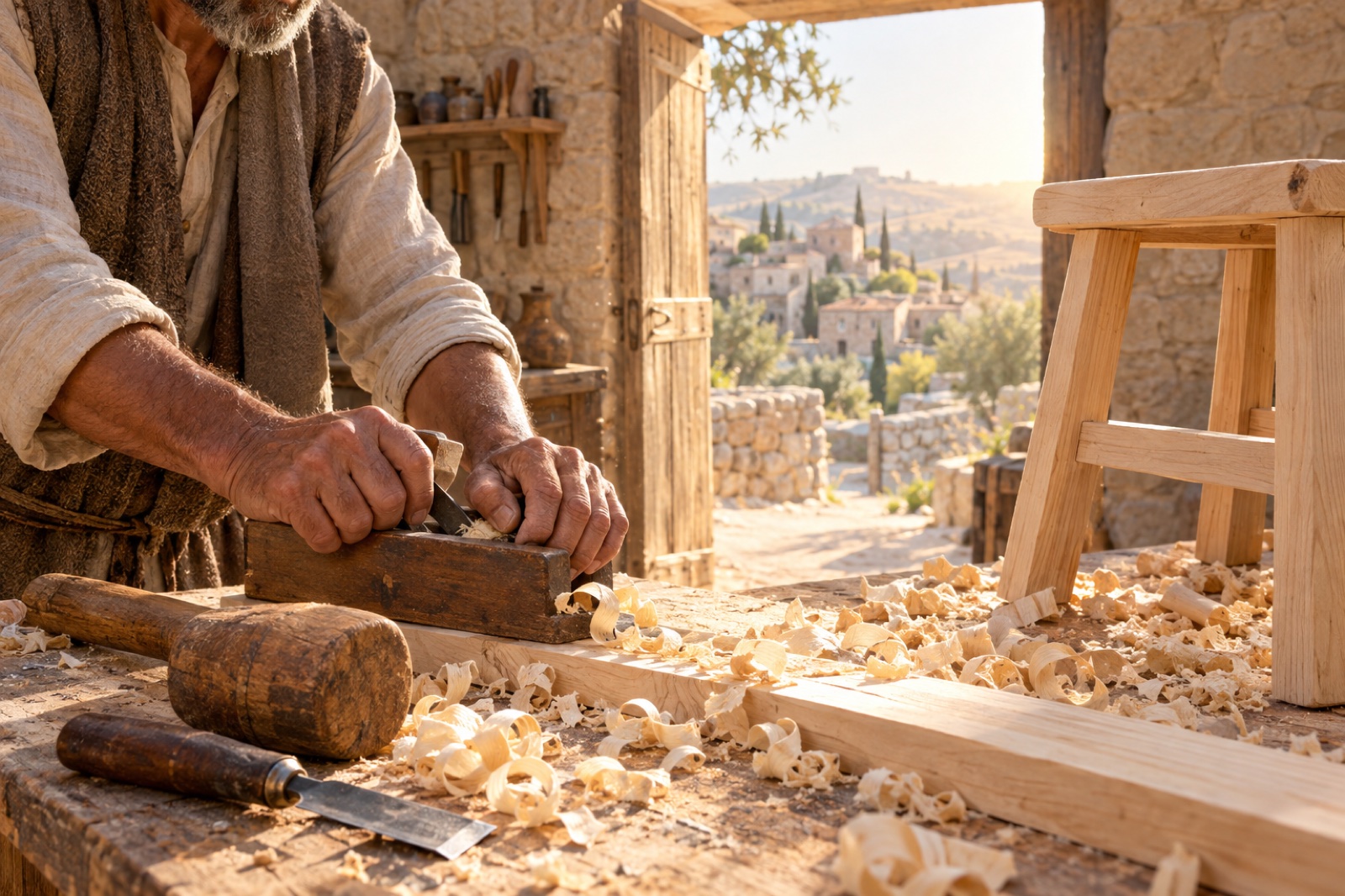
Matthew tells the same scene with slightly different wording — “Is not this the carpenter’s son?” (Matthew 13:55) — so from these two verses alone we cannot say for certain whether the trade was his, his father’s, or both. What they agree on is the setting: a working family, a small town, a known job, sawdust.
Now sit with what the townspeople are actually arguing. Their evidence against Jesus is that he was too ordinary to be anything. They had watched him work. They had probably sat on furniture he made. Eighteen years of unremarkable Tuesdays were the strongest objection they could come up with — and those years were not a delay before the real thing. They were part of the life we are told to follow.
Paul’s Strangest Piece of Advice
Years later, Paul wrote to a young church in Thessalonica that was doing well. He had just told them their love for one another should “increase more and more” (1 Thessalonians 4:10). Then comes the instruction, and it is not the one you would expect from a man who crossed an empire on foot:
“And that ye study to be quiet, and to do your own business, and to work with your own hands, as we commanded you; That ye may walk honestly toward them that are without, and that ye may have lack of nothing.” — 1 Thessalonians 4:11-12
“Study” in older English does not mean sitting down with a book. It carries the sense of striving, of making a thing your aim. So read it back as the ambition it is: make it your ambition to be quiet. Mind your own business. Work with your hands. Paul puts that in the same breath as love increasing more and more, which means he did not see the two as different projects.
Then he gives the reason, and the reason is the whole everyday-life answer: “that ye may walk honestly toward them that are without.” Those on the outside. The neighbour, the shift supervisor, the person at the next desk, your brother-in-law. Paul’s picture of a believer’s witness is not a platform and not a speech. It is a life so steady and so honest in its ordinary dealings that the people watching have no reason to doubt it.
What Actually Changes on a Tuesday
If the tasks stay the same, what moves? The audience does.
“And whatsoever ye do, do it heartily, as to the Lord, and not unto men” — Colossians 3:23
That one line relocates your whole day. Same inbox, same kitchen, same shift — different person you are doing it for. In practice it shows up in small, unglamorous places:
- You finish the part of the job nobody is going to inspect.
- You make the apology the same day instead of three weeks later, because you are no longer defending a reputation.
- You stay out of the pile-on in the group chat, and nobody notices, which is the point.
- You are patient with the person who tests it, in a way that surprises even you.
Paul goes as far as the dinner table: “Whether therefore ye eat, or drink, or whatsoever ye do, do all to the glory of God” (1 Corinthians 10:31). Nothing on that list is religious activity. And the one marker Jesus himself named for his followers was relational, not religious: “By this shall all men know that ye are my disciples, if ye have love one to another” (John 13:35).
Here is what that feels like a few weeks in. The anxious question — am I doing this right? — gets quieter, because the answer stops depending on how spiritual the day felt. Monday morning has a shape to it. You are not performing for the people who score you anymore, and that is a lighter way to carry a week.
Three Things It Does Not Mean
- It does not mean stacking religious activity on top of an already full day. Paul’s instruction was to work with your hands, not to add a second shift of spiritual tasks.
- It does not mean becoming unrecognisable to the people who live with you. Jesus stayed in his own village, in his own family, in his own trade, for most of his life.
- It does not mean every hour feels spiritual. Luke’s word for the young Jesus is “increased” — a slow growth word, measured in years, not in moments.
If the underlying definition is what you are after — where the word “Christian” even came from, and who first used it — this piece on what it means to be a Christian starts in a city called Antioch. And if you are doing all this without a church around you yet, what to do as a new Christian without a church is the honest version of that situation.
The One Thing That Has to Be Recent
A day takes its shape from whoever you were last listening to. That is true of the news, of a difficult coworker, of whatever you scrolled before bed. It is just as true of Jesus. The reason faith goes flat on a Tuesday is rarely a lack of effort. It is usually that it has been a while since you heard him say anything in his own words, so the voice shaping your morning is somebody else’s.
Which makes the habit that holds everyday faith together remarkably small: spend a few minutes with Jesus recently enough that you still remember what he sounds like. Not a study programme. Not an hour. Ten minutes in the Gospels before the day starts will do more to shape eleven o’clock than an afternoon of resolve. If you want a route through it, here is a new believer Bible reading plan that takes about that long.
A Plan Built for an Ordinary Week
That is exactly what 30 Days Walking with Jesus is for. It walks through the life of Jesus one day at a time, straight through the Gospels, and it is built for someone starting from the beginning. Each day has a short devotional video under 60 seconds. There are 30 full-chapter audio readings for the days when listening is easier than reading — a commute, a kitchen, a walk. There is a complete PDF study guide with journal prompts, and 5 quick-reference scripture guides. The whole thing takes under 10 minutes a day.
And it is completely free. No payment, no card, no upsell, no expiration — because the words of Jesus should not sit behind a paywall. You get instant access on any device, and it is yours to keep. Thirty ordinary mornings with him, and then see what your Tuesdays look like.
Questions People Are Asking
Q: What does it mean to be a Christian in everyday life?
A: It means doing an ordinary day for a different audience. Colossians 3:23 puts it plainly: “And whatsoever ye do, do it heartily, as to the Lord, and not unto men.” The tasks usually stay the same — the work, the family, the errands — while the reason behind them changes, and the way you treat people changes with it. Jesus named love for one another as the mark outsiders would recognise: “By this shall all men know that ye are my disciples, if ye have love one to another” (John 13:35).
Q: Does being a Christian mean I have to change my job or my routine?
A: Not according to the New Testament. Paul told the church in Thessalonica to “study to be quiet, and to do your own business, and to work with your own hands” (1 Thessalonians 4:11) so that they would “walk honestly toward them that are without” — meaning their ordinary working life was itself the witness to outsiders. Jesus himself is called “the carpenter” in Mark 6:3, and Luke 3:23 says he was “about thirty years of age” when his public ministry began, so most of his own life was spent in a trade in a small town.
Q: Why does my faith feel flat on a normal weekday?
A: Very often it is not a willpower problem but a distance problem: it has been a while since you actually heard Jesus speak in his own words, so something else is shaping your day. Reading a short passage from the Gospels of Matthew, Mark, Luke or John each morning, and praying about it in plain language, keeps his voice recent. Luke 2:52 describes the growth of Jesus himself as increasing “in wisdom and stature” — a gradual word. Flat stretches are not evidence that something has gone wrong.
Q: Do I need to do religious activities every day to count as a Christian?
A: The Bible’s emphasis falls on belonging to Jesus and on how you live, not on a checklist. 1 Corinthians 10:31 covers the least religious things imaginable — “Whether therefore ye eat, or drink, or whatsoever ye do, do all to the glory of God” — which means everyday life is not a lesser category of faith. A small daily habit of time with Jesus helps enormously, but it is a relationship, not a quota.
Q: Where should a new Christian start reading the Bible for everyday life?
A: Start with one of the four Gospels, because they record what Jesus said and did, and that is the pattern everything else is measured against. 30 Days Walking with Jesus, a free plan from BGodInspired, walks through the life of Jesus in the Gospels one day at a time in under 10 minutes a day, with a short devotional video, full-chapter audio readings, and a PDF study guide with journal prompts. There is no payment and no card required.