 0
 0
A young man is on a train. His father is dying at home, and he has just walked out on him. In his hands is a very long letter, and the writer has told him that by the time he reads it, the writer will already be dead.
That is where the first two-thirds of Kokoro leave you. Natsume Soseki ran the novel in the Asahi Shimbun newspaper in 1914, under a longer title that translates roughly as “Sensei’s Testament,” and it has been one of the most-read novels in Japan ever since. Readers who come back to ask about the Kokoro meaning usually start with that letter. They want to know why a quiet, kind, wealthy man who had done nothing anyone could see decided he had to die.
The answer is in the letter. But the more interesting question is why it had to be a letter at all.
What happens in Kokoro
The novel has three parts. In “Sensei and I,” a student on summer holiday at the beach in Kamakura attaches himself to an older man he only ever calls Sensei, a word for a teacher or respected elder. The book opens by telling you it will never give his real name. Sensei has no job, reads a great deal, and is married to a gentle woman named Shizu. Once a month he visits a grave at Zoshigaya cemetery in Tokyo. He will not say whose it is. He keeps hinting that he is not a man worth admiring, and keeps promising that one day he will tell the student why.
In “My Parents and I,” the student graduates and goes home to the country, where his father is slowly dying. Emperor Meiji dies that summer. Not long after, General Nogi takes his own life to follow his emperor in death. A telegram arrives from Sensei asking the student to come to Tokyo. He can’t leave his father. Then the letter comes.
The third part, “Sensei and His Testament,” is the letter, and it is about half the novel. As a student, Sensei lodged with a widow and her daughter. He fell in love with the daughter. He brought his closest friend, a poor, fiercely disciplined young man the letter only calls K, to live in the same house. K fell in love with her too, and told Sensei so. Sensei said nothing about his own feelings. Instead he used K’s own hard ideals against him, then went behind his back and asked the widow for her daughter’s hand. She said yes. K found out from the widow, not from Sensei. A couple of nights later, K took his own life.
Sensei married the daughter. That is the woman the student knew as Shizu. The grave was K’s.
The secret was never found out
Here is the detail that makes Kokoro so hard to shake. K left a note, and it did not accuse Sensei. It thanked him and asked him to take care of things. It never mentioned the daughter. In Edwin McClellan’s translation, Sensei admits that his first thought on reading it was “I’m safe.”
And he was. Nobody ever knew. The widow didn’t know, his wife didn’t know, and the world went on treating him as a decent, quiet man. He was never caught. That is exactly what destroys him.
Most stories about guilt are about the fear of being exposed. Kokoro is about what happens when exposure never comes. Sensei spends decades as the only living person who knows what he did. The secret stops being something in his past and becomes the shape of his whole life. It’s the reason he won’t work, why he won’t be close to anyone, and why the student’s admiration seems to hurt him. He tells his wife nothing because, he writes, he does not want to stain her life with something ugly. So the one person he lives with is the one person he has to perform for every day.
Soseki doesn’t let this turn into a ghost story or a thriller. Nobody suspects. The pressure doesn’t come from outside. It is just a man and the thing he knows, year after year, in a comfortable house. If you have read our piece on what No Longer Human is really about, you will notice how different this is. Dazai’s narrator feels unfit to be human from childhood. Sensei is entirely fit. He simply did one thing, and could not say it.
The door between the two rooms
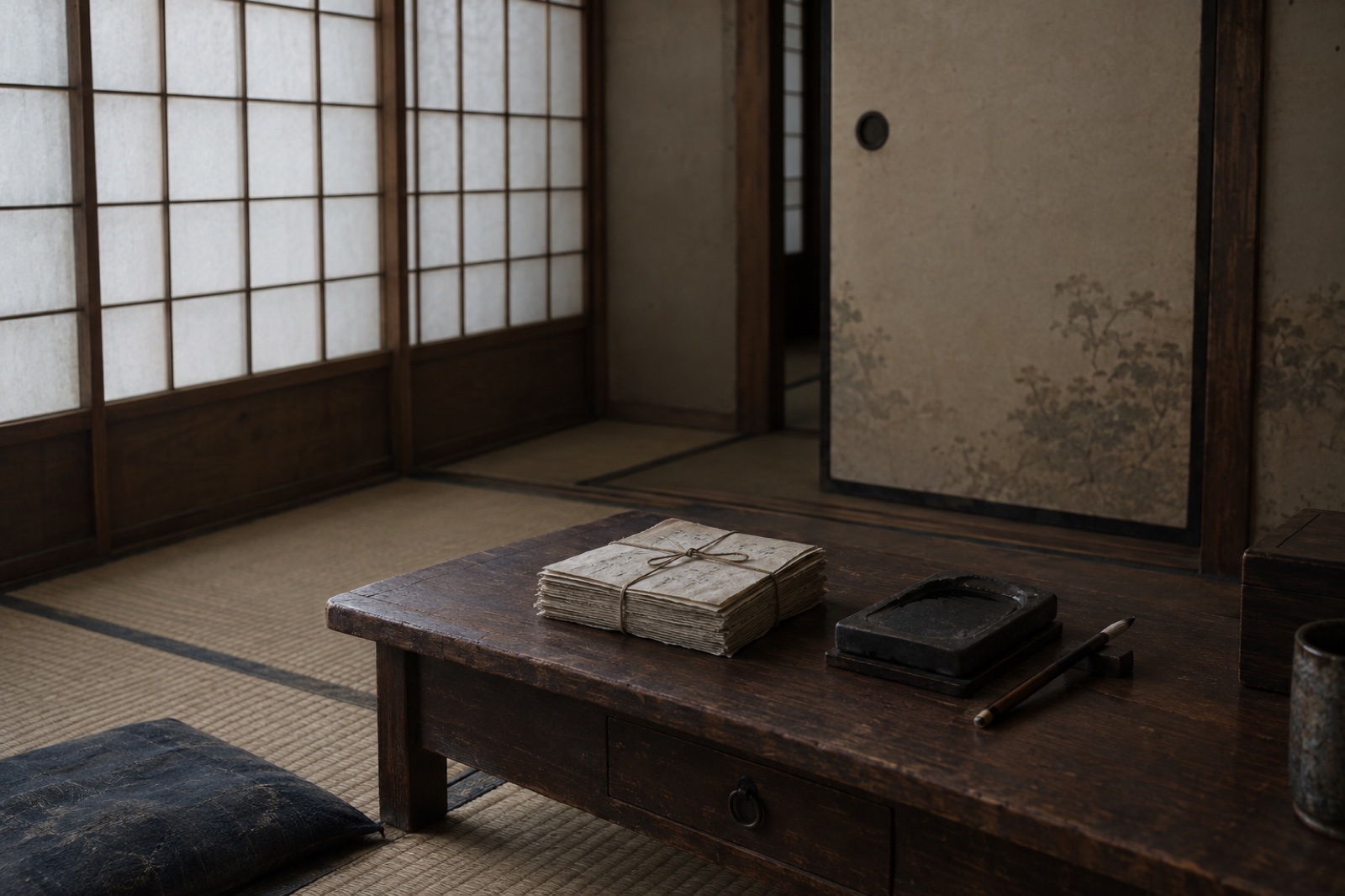
This is easy to miss on a first read, because it’s buried in the furniture. Sensei’s room and K’s room are joined by a sliding paper door. Soseki keeps coming back to it.
When K confesses his love, the door between their rooms suddenly slides open and K is standing there, looking in. Then he walks in and sits down across from Sensei and tells him. Later, one night, K opens the same door in the dark and calls to him from the doorway. On the night K dies, Sensei wakes and sees that the door between the rooms is ajar.
Look at who does the opening. In each of those scenes, it is K. K is the one who crosses the threshold to say the hard true thing to a friend’s face, and K is the one who reaches through it one last time. Sensei never comes through that door. He confesses at last, but in writing, sealed, and timed to arrive after he is gone. It is a confession built so that nobody can walk into the room and answer it.
That shape repeats at the scale of the whole book. Part three swallows the novel. The student’s own voice, which carried us through two-thirds of it, just stops. Soseki never brings him back to say what he thought, what he did when the train arrived, or whether he reached Sensei’s house in time for anything. The letter gets the last word because a letter from the dead cannot be argued with, comforted or forgiven. Sensei finally tells the whole truth, and he has arranged things so that it can only ever be a monologue.
And there is one more small, sharp thing. The letter ends with a request. While his wife is alive, the student must keep all of it secret, even after Sensei is dead. But in the novel’s opening pages the student is already writing about Sensei, by the name he chose for him, and he tells us Sensei is dead. The book in your hands is the secret, told. Soseki never says how. Either Shizu has died by the time the student writes, or he has decided the truth matters more than the promise. The novel leaves you to choose, and either way it implies that Sensei’s carefully sealed confession did not stay sealed. Sooner or later the truth found an audience after all.
Kokoro meaning: a confession needs someone to answer it
The word kokoro means heart, but in a fuller sense than the English word carries: the heart as mind, feeling and inner self all at once. A heart is exactly what Sensei keeps behind the door. He tells the student he is giving him his past because the young man was the only one who ever sincerely asked for it. That is true, and it is moving. But it also lets him hand his heart to someone he didn’t wrong, someone who can’t reply, at a moment when no reply is possible.
There is a very old idea underneath this, older than Soseki and older than Japan’s Meiji era. In the letter of James, the instruction about confession isn’t “write it down” or even “admit it.” It says to confess your faults one to another, and pray one for another, so that you may be healed (James 5:16). The phrase that matters is one to another. In that old picture, confession is a door that opens both ways. You say the true thing to a living face. Then someone on the other side gets to answer, and the answer is part of the healing.
Sensei got the first half. He finally told the truth, completely and without excuses, in some of the most honest pages in modern fiction. What he never allowed was the second half: a person in the room, saying something back. K tried to give him that twice, through an open door, and he let it close. Shizu could have given it to him every day for decades. He protected her from it instead, and protected himself from whatever she might have said.
It would be dishonest to say the novel agrees. Kokoro doesn’t imagine a way out for Sensei, and it doesn’t mourn the path he didn’t take. It holds his choice with a kind of grave respect and ties it to the passing of a whole generation. But the structure Soseki built tells on him anyway. The only character who keeps opening the door is the one whose death the book is about. And the man who never opens it ends up confessing to someone who can only read the words, after he is gone.
Where the novel leaves you
The last image Kokoro gives you is not a funeral or a reunion. It is a young man on a train, reading, with his father’s deathbed behind him and a dead man’s voice in his hands. Soseki stops there, before the student can say a word.
That silence is the book’s real ending. A hundred years of readers have filled it in for themselves, which might be the point. Someone finally has to answer Sensei, and since the student never gets the chance, the novel quietly hands that job to you. If you liked how Kokoro pulls apart confession and consequence, J.M. Coetzee’s very different take is worth reading next: our reading of the ending of Disgrace looks at a man who confesses twice, once to save his job and once for nothing.
Discussion question
Do you think the student kept Sensei’s request, or broke it on purpose by telling the story? Does it change how you read the whole novel? Tell us in the comments.
Questions About Kokoro
What is the meaning of Kokoro by Natsume Soseki?
Kokoro by Natsume Soseki (1914) is about a man who betrayed his closest friend in love, was never found out, and spent the rest of his life carrying the secret alone. The novel’s deeper subject is the difference between being exposed and actually confessing. Sensei is never caught, but his secret shapes his whole life, and he only tells the truth in a letter written to be read after his death.
Why did Sensei kill himself in Kokoro?
In Kokoro, Sensei has carried the guilt of his friend K’s suicide for decades. K died shortly after learning that Sensei had secretly arranged to marry the woman K loved. Sensei never told anyone, including his wife. After Emperor Meiji dies and General Nogi follows him in death, Sensei writes that he will die out of loyalty to the spirit of the Meiji era, the age he belonged to. The letter shows that decades of hidden guilt had long since prepared him for that choice.
Who is K in Kokoro?
K is Sensei’s friend from his hometown in Natsume Soseki’s Kokoro. He is a priest’s son who had been adopted into a doctor’s family and was disowned for pursuing religion and philosophy instead of medicine. Sensei brings K to live in the same lodging house, where both fall in love with the landlady’s daughter. K confesses his feelings to Sensei, who then secretly asks for the daughter’s hand himself. K takes his own life soon afterwards, and is never named beyond the initial.
Does Sensei’s wife ever find out the truth in Kokoro?
Not within the story. In Kokoro, Sensei never tells his wife Shizu about his betrayal of K, and his letter asks the narrator to keep everything secret for as long as she is alive. The novel itself is the narrator’s account of Sensei, though, which leaves readers to wonder whether Shizu has died by the time he writes, or whether he chose to break the promise.
Is Kokoro worth reading in English?
Yes. Kokoro is short, plainly written and one of the most widely read modern Japanese novels. The best-known English versions are Edwin McClellan’s translation (1957) and Meredith McKinney’s (2010). It is a good entry point to Japanese literature because it needs no background beyond the basic fact that Emperor Meiji’s death in 1912 marked the end of an era.
Social Share Posts
In Kokoro, every time the door between Sensei’s room and K’s really matters, it’s K who opens it. Sensei never comes through. His confession comes as a letter timed to arrive after he’s gone.
The cruelest thing in Soseki’s Kokoro is that Sensei is never found out. K’s note doesn’t blame him. He gets away with it completely, and getting away with it is what slowly undoes him.
Sensei asks the narrator to keep his secret as long as his wife lives. The novel is the narrator telling it. Did he wait, or did he decide the truth mattered more?