 0
0
 0
0
There is a bottle of oil within a few steps of where you are sitting right now. Olive, sunflower, whatever is cheapest where you live. It is the most ordinary thing in the kitchen, and you reach past it a dozen times a day without once thinking about it.
Which makes it strange that oil turns up at almost every hinge point in the Bible. Kings are made with it. Lamps burn it. Wounds are washed in it. A widow drowning in debt is rescued by it. And on the last night of his life, Jesus walks to a place that is named after the machine that makes it.
So what is the oil meaning in the Bible? Not a secret code, and not decoration. It is one ordinary substance doing three extraordinary jobs. And all three of them depend on something happening first that nobody would ever volunteer for.
Oil Meaning in the Bible: One Substance, Three Jobs
The Hebrew word is shemen, and almost always it means olive oil. In the ancient world this was not a luxury. It was fuel, food, medicine and soap all at once, probably the most useful thing a household could own.
Scripture puts it to work in three ways. It helps to see them separately first, because what holds them together is the part most people never get told.
- Light. Oil kept the lamps burning in the place of worship.
- Healing. Oil was poured into wounds and over the sick.
- Anointing. Oil marked a person as chosen and set apart.
Three jobs, one jar. Hold on to that, because the thread running through all three is where this gets interesting.
Light: The Oil That Had to Burn Always
The instruction for the lamp is oddly specific:
“And thou shalt command the children of Israel, that they bring thee pure oil olive beaten for the light, to cause the lamp to burn always.” (Exodus 27:20, KJV)
Read it again and notice one word: beaten. The Hebrew term describes olives crushed by hand rather than ground in a mill. This was the first pressing, the purest run, and it was the only grade good enough for the lamp.
Then notice the end of the sentence: “to cause the lamp to burn always.” That light did not run itself. Somebody had to carry oil in, day after day, or the room went dark. The most sacred light in Israel depended on an ordinary person making an ordinary delivery, over and over, for years.
If you have ever felt that your faith is mostly unglamorous maintenance rather than lightning bolts, Exodus 27:20 is quietly on your side.
Healing: Oil Poured Into Open Wounds
When Jesus tells the story of a traveller beaten and left at the roadside, the rescuer does something very physical:
“And went to him, and bound up his wounds, pouring in oil and wine” (Luke 10:34, KJV)
Oil softened and sealed; wine cleaned. This was the ordinary first aid of the time, and that is exactly the point. The hero of the story does not pray over the man from a distance. He kneels down and spends his own supplies on a stranger’s injuries.
The early church kept the practice. “Is any sick among you? let him call for the elders of the church; and let them pray over him, anointing him with oil in the name of the Lord” (James 5:14, KJV). Prayer and oil, together. Words and touch, together.
Anointing: The Recipe Nobody Was Allowed to Copy
The third job is the strangest one. A special blend was mixed for anointing, described as “an ointment compound after the art of the apothecary: it shall be an holy anointing oil” (Exodus 30:25, KJV). Then comes a rule that stops you short:
“Upon man’s flesh shall it not be poured, neither shall ye make any other like it, after the composition of it: it is holy, and it shall be holy unto you. Whosoever compoundeth any like it, or whosoever putteth any of it upon a stranger, shall even be cut off from his people.” (Exodus 30:32-33, KJV)
You could not bottle it. You could not wear it casually. You could not reproduce the formula for your own use. In a world where oil was in every kitchen, this one batch was fenced off entirely, which tells you what anointing was understood to mean. It was not a fragrance. It was a marking.
And when the marking happened, something happened with it:
“Then Samuel took the horn of oil, and anointed him in the midst of his brethren: and the Spirit of the LORD came upon David from that day forward.” (1 Samuel 16:13, KJV)
A shepherd boy, the one nobody had bothered to call in from the field, gets oil poured over his head in front of the brothers who overlooked him. That is the whole picture of anointing in one scene: chosen before qualified.
This is also where the most familiar word in Christianity comes from. “Messiah” simply means anointed one — the title is literally built from this oil. We trace that word all the way down in the Hebrew word for Messiah, and it is why the woman who broke open a jar of costly ointment over Jesus was doing something far bigger than the room realised, a moment we look at in this piece on the alabaster jar.
The Detail Almost Everyone Reads Past
Here is the thread, and once you see it you cannot unsee it.
Light, healing, anointing. Every one of them requires oil. And oil does not exist in nature. There is no tree that drips it.
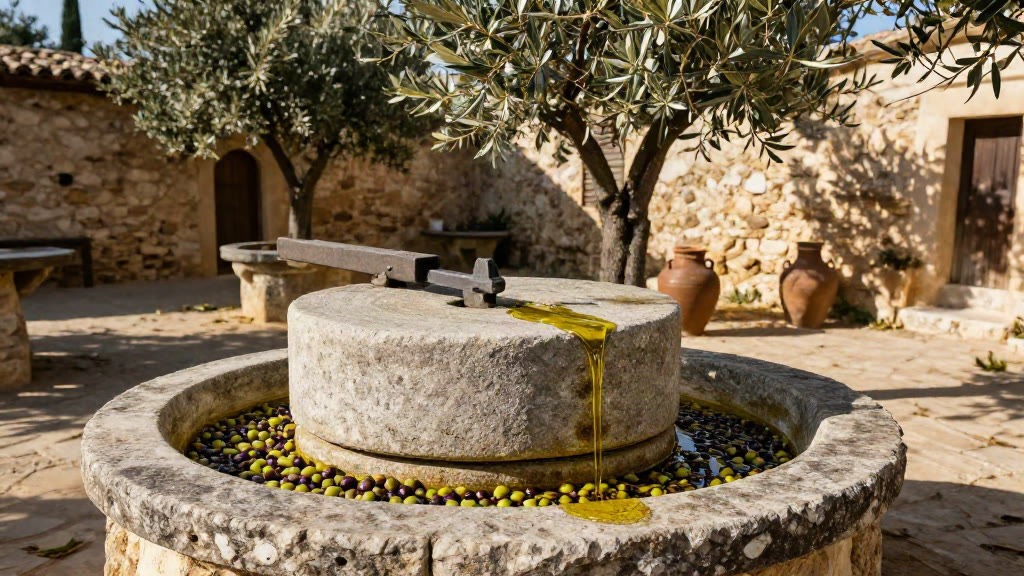
An olive is bitter and inedible straight off the branch. To get oil out of it, the fruit has to be broken open under weight — crushed between stones until what is inside runs out. The lamp could not burn, the wound could not be treated, and the king could not be anointed until something had been pressed.
The Bible never stops to underline this. It simply assumes you know where oil comes from, the way it assumes you know where bread comes from. Every ancient reader had walked past a press. We are the ones who buy it in bottles and forget.
The Garden Named After a Machine
Which brings us to the last night.
“Then cometh Jesus with them unto a place called Gethsemane, and saith unto the disciples, Sit ye here, while I go and pray yonder.” (Matthew 26:36, KJV)
The name Gethsemane comes from two words meaning oil press. It was a working olive grove on the Mount of Olives, with the stone equipment to match. That is not a clever reading of the text. That is just what the place was called, and what it was for.
So on the night before the cross, under the weight of what was coming, Jesus goes and kneels in a place whose name means the press. Scripture does not pause to point at it. It gives the location its ordinary name and moves straight on to the prayer, which somehow makes it land harder. We sit with that night more closely in the night Jesus said it out loud.
Oil for light, oil for healing, oil for anointing. All of it comes out of a press. And the one called the Anointed One went to the press himself.
What This Means for the Week You Are Actually In
Be careful here, because this truth has a counterfeit twin. “You are being crushed so you can produce something” can be said in a cold way that treats your hardest season as a factory process, and it can be used to hurry people past grief that deserves time. God is not standing over you with a stone, looking for output.
The honest comfort is smaller and better than that. It is simply this: in Scripture, pressure is not evidence of being discarded. The olive in the press has not been thrown away. It is in the one place where what is inside it can finally get out.
And whatever you are under this week, you are not under it alone, and you are not under it unrecognised. The place where Jesus prayed shares a name with the place where the oil is made.
A good place to start: The Beginner’s Guide to Feeling God’s Presence Every Day. A simple guide to noticing God in ordinary moments, especially the heavy ones. Get the free guide. Free.
Actions to Take Today
- Pick up the oil in your kitchen and read one verse. Hold the bottle, read Exodus 27:20, and put it back. Two minutes. It permanently changes an object you look at every day into a reminder.
- Do one “pouring in oil” thing for somebody. The Samaritan used what he already had on him. Send the message, carry the bag, sit with the person. Pick something physical and small enough to finish today.
- Name your press out loud. Say the sentence plainly to God: “This is the thing pressing on me right now.” Not a polished prayer. Just the name of it, said honestly.
Journal Prompts
- Which of the three jobs of oil do you most need right now: light to see by, healing for something raw, or the reminder that you were chosen before you were qualified?
- Samuel anointed David in front of the brothers who had left him out in the field. Where have you been quietly counted out, and what would change if you knew you had not been?
- What is one thing you have only learned because of a season that squeezed you? Write it down without deciding yet whether the season was worth it.
A Prayer for When You Feel Pressed
God, I am tired of being squeezed, and I do not have a good attitude about it today. I am not going to pretend this is easy or that I understand what it is for. But thank you that pressure is not the same as being thrown out, and that Jesus knelt down in a place named after a press and did not run. Help me notice the light I still have. And if anything good is being made in me right now, please let some of it reach somebody else.
Let’s Talk About It
Why do you think the Bible so often uses everyday working objects — oil, bread, water, salt — to carry its biggest ideas, instead of grand and unusual images? Leave a comment below, I would genuinely like to hear your take.
Share This
- Just learned the lamp oil in Exodus 27:20 had to be “beaten” — crushed by hand. Light, healing and anointing in the Bible all start the same way: something gets pressed.
- Gethsemane means “oil press.” The night before the cross, Jesus went and knelt in a place named after the thing that crushes olives. The Bible doesn’t even stop to point it out.
- An olive is bitter and useless straight off the tree. It has to be broken open before anything good comes out. I needed that this week.
Q&A: Oil Meaning in the Bible, Answered
What does oil symbolise in the Bible?
Oil in the Bible is used for three main purposes: light, healing and anointing. Olive oil fuelled the lamps in Israel’s place of worship (Exodus 27:20), was poured into wounds as medicine (Luke 10:34) and over the sick with prayer (James 5:14), and was used to anoint people chosen for a particular role, as when Samuel anointed David in 1 Samuel 16:13. All three uses depend on olives first being crushed in a press.
Why did the lamp oil have to be “beaten”?
Exodus 27:20 calls for “pure oil olive beaten for the light, to cause the lamp to burn always.” The Hebrew word describes olives crushed by hand rather than ground in a mill, producing the first and purest pressing. Only that grade was used for the lamp, and because the lamp was to burn continually, fresh oil had to be supplied regularly rather than once.
What does Gethsemane mean?
The name Gethsemane comes from words meaning “oil press.” It was an olive grove on the Mount of Olives equipped for pressing olives into oil. Jesus went there to pray on the night before his crucifixion, as recorded in Matthew 26:36. Scripture reports the name without commenting on it.
Why was the holy anointing oil forbidden to copy?
Exodus 30:32-33 states that the holy anointing oil was not to be poured on ordinary people, reproduced by anyone, or placed on a stranger, and that whoever copied it would be cut off from the people. Because oil was common in every household, setting this one blend apart marked anointing as a designation for a specific God-given role rather than a perfume or a cosmetic.
Does oil represent the Holy Spirit in the Bible?
Many Christians connect oil with the Holy Spirit, and the clearest support is 1 Samuel 16:13, where Samuel anoints David with oil and the Spirit of the LORD comes upon David from that day forward. The Bible does not state a direct formula that oil equals the Holy Spirit, so it is best understood as a pattern observed across passages rather than a defined symbol.