 0
0
 0
0
Here is how a mental health crisis usually goes.
Someone stops sleeping. Stops eating properly. Starts saying things that frighten the people who love them. Eventually a service gets involved. A stranger asks questions. A decision gets made about that person — often in a room that person is barely in, and almost never in alongside their own family.
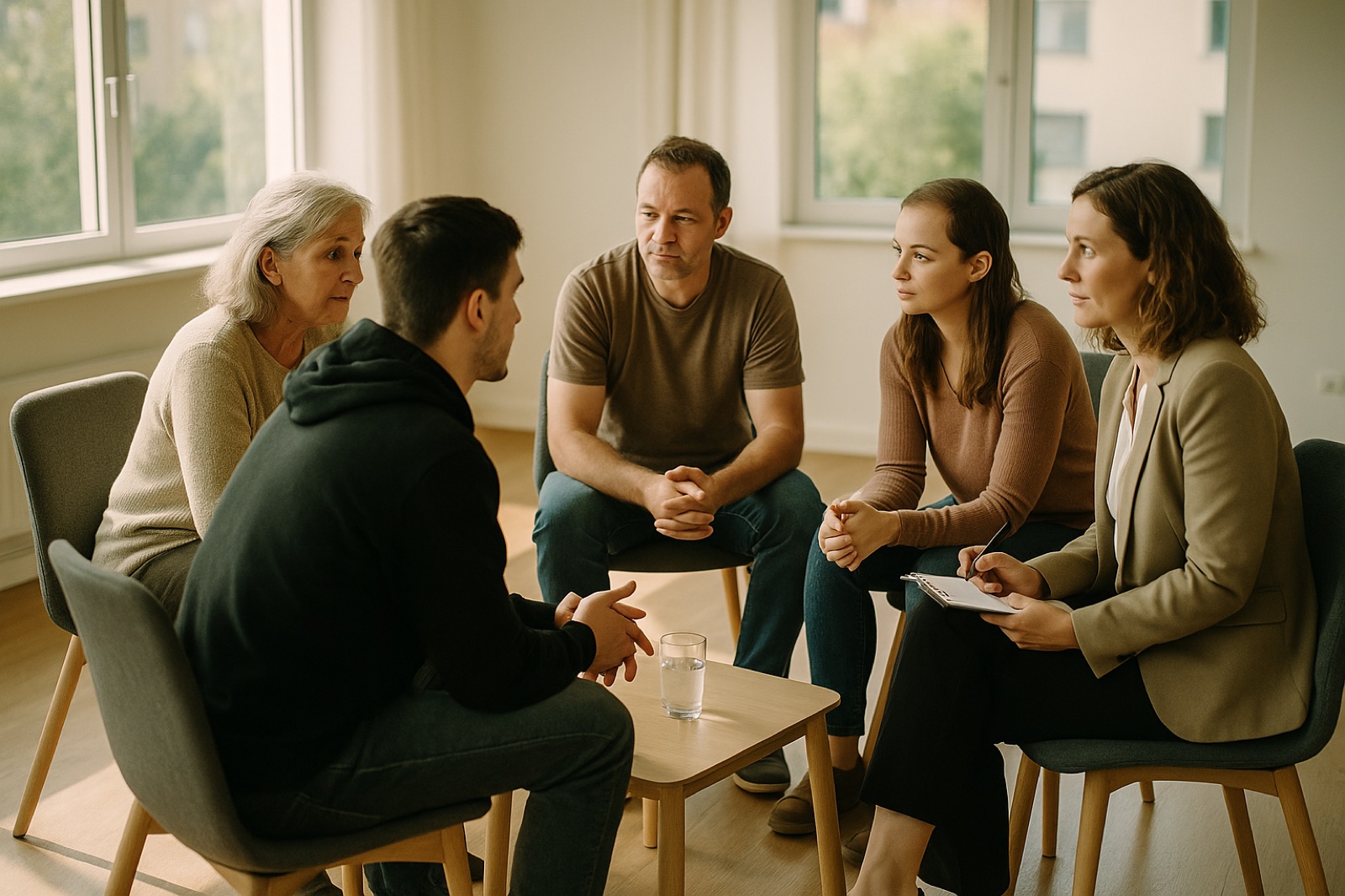
Five mental health services in England tried the opposite. They brought the family and friends in. Not later, once things had settled. From the first meeting.
The Open Dialogue trial that tested this was published in August 2026, and the results are stranger — and far more interesting — than the headlines about them.
What Open Dialogue Actually Is
Open Dialogue is a way of running a mental health team, not a type of therapy you book. It grew out of services in Finland from the 1980s, and it rests on a handful of plain ideas.
- Answer fast. When someone reaches out in crisis, they get seen quickly rather than placed on a list.
- Same faces. The people in the first meeting stay with you through the next ones.
- Bring the network. Family, partners, friends — whoever the person wants — sit in the meeting too.
- Nothing decided about you without you. The talking happens in front of the person, not in a corridor afterwards.
- Sit with not knowing. The team is allowed to say it does not have the answer yet, out loud, instead of rushing to a label.
That last point sounds soft. In practice it is the hardest one, because every system is built to produce a decision quickly.
What the Open Dialogue Trial Found
The study was called ODDESSI, and it was the first randomised trial of Open Dialogue anywhere. It ran across five National Health Service mental health services in England and followed 494 adults who came to those services in crisis — 271 in the Open Dialogue group, 223 in usual care. Whole doctors’ practices were assigned to one approach or the other, because you cannot run two opposite philosophies inside one team without them bleeding into each other.
The main question the trial set out to answer was about relapse: once someone recovered from the crisis, would Open Dialogue keep them well for longer?
It did not. Two years after recovery, about 54% of the Open Dialogue group and 49% of the usual-care group had still not relapsed — a gap small enough to be chance. On the measure the whole study was designed around, the two approaches looked the same.
Then came the results nobody designed the study to find.
In the raw figures, 21% of the Open Dialogue group were admitted to a psychiatric inpatient ward at some point. In usual care it was 44%. After the researchers adjusted for differences between the groups, the Open Dialogue group had more than three times the odds of never being admitted at all.
Worth being precise here, because this is where the reporting slipped: that is not the same claim as “three times less likely to be admitted.” It is the odds of never being admitted across two years. Being sent to hospital once still counts.
Alongside that, 40% of the Open Dialogue group were referred back to crisis or specialist services, against 60% in usual care. People in the Open Dialogue group also rated their own recovery and their general health better at two years, and were more satisfied with the service at three months. Safety held up: of 386 serious adverse events recorded, 376 were judged to have nothing to do with the approach being tested. You can read the published trial in full.
The Part Nobody Expected
Here is the detail that makes this trial worth your time, and it is buried in the secondary results.
The entire theory behind Open Dialogue is the network. Bring the person’s people in, and the person’s people become part of how they get well. So the researchers measured exactly that. They looked at how big each person’s social network was, and how good it was.
Neither improved enough to count.
Commenting on the findings, Dr Sameer Jauhar of Imperial College London put it flatly: “There was no significant improvement in either the size or quality of participants’ social networks.” And he asked the obvious follow-up — if the thing the approach is supposed to work through did not measurably change, what was driving everything else? You can read the full expert reaction here.
It is a fair challenge. It is also, read a different way, the most hopeful sentence in the whole study.
Because look at what it means. Nobody in that trial was handed a bigger circle. Nobody’s family suddenly became warmer, or more available, or better at saying the right thing. The number of people in these lives stayed roughly where it was. Nothing was added.
Something was just stopped being left out.
The same flawed, tired, half-estranged, doing-their-best people who were already there — the mother who talks too much, the brother who goes quiet, the friend who keeps showing up with the wrong food — got moved from the waiting area into the room. That alone tracked with half as many hospital admissions.
So What Was Doing the Work?
Honestly: nobody knows yet, and the people who ran the trial say so themselves. A few candidates are on the table.
Speed. Jauhar points out that the drop in admissions was sharpest in the first 14 days. That may say more about how quickly a worried family gets someone seen than about anything that happened in the meetings.
Continuity. Telling your story once, to people who will still be there next month, is a different experience from telling it five times to five strangers.
A different threshold. A team sitting with a whole household may read risk differently from a team sitting with one frightened person alone. And fewer admissions is not automatically a good thing. Hospital can be the right call. Sometimes it saves a life.
The limits are worth stating as plainly as the findings:
- The measure the trial was built to test — relapse — showed nothing. The encouraging results were secondary, and were not adjusted for the fact that many things were measured at once. Jauhar calls them exploratory at best.
- Nobody was blinded. Staff and participants all knew which approach they were in.
- About 69% of participants were White British, and enough English was needed to take part. Nobody should assume the same result elsewhere.
- Professor Richard Morriss of the University of Nottingham notes that the same NHS trusts ran both arms, and staff move between services, so some blurring between the two approaches is likely.
- Part of the study ran while restrictions on home and face-to-face visits were still in place after COVID.
Which is a long way of saying this is a beginning, not a verdict. A health-economic analysis is still to come, and the authors are clear that more work is needed before anyone rebuilds a service around it.
What Any of Us Can Borrow From This Week
None of what follows needs money, a diagnosis, a therapist, or spare time. Which is the point.
- Decide who your two people are now, while things are calm. Not who should be. Who actually would. Write the names somewhere you will find them.
- Tell them before you need them. One sentence does it: “If I ever go quiet for more than a few days, come and knock.”
- Take someone with you. To the appointment, the phone call, the assessment. Ask them to listen and remember, not to speak for you.
- If you are the one on the outside, ask to be let in rather than pushing in. “Do you want me in the room?” is a question that respects someone and still offers everything.
- Name the specific thing. “How are you” is easy to deflect. “Can you sit here for an hour and not fix anything” is hard to deflect, and much easier to say yes to.
If you are not sure how thin your circle has quietly become, our free How Lonely Am I? check takes about two minutes and nobody sees the result but you.
And to be unmistakably clear: none of this is a replacement for treatment. The trial did not test people instead of care. It tested people inside care. If you are unwell, get help — and take someone with you.
There is a southern African word for the idea underneath all of this, and it is far older than any trial: ubuntu — a person is a person through other people.
A good place to start:
Why Your Mind Won’t Slow Down at Night (Free)
It explains why the mind speeds up the moment the house finally goes quiet, and walks through the 5-step order that settles it. Get the free guide.
Free.
An Old Pattern
There is something quietly familiar about a trial that found its answer in who was in the room.
The oldest stories we have about people getting well are almost never about someone recovering alone. They are crowded stories. Somebody gets carried. Somebody tears open a roof because the door is blocked. Somebody refuses to be sent away and keeps shouting from the back. In the version of that roof story people have retold for two thousand years, the first thing anyone notices is not the sick man’s hope at all — it is the determination of the friends who hauled him there. Long before anyone thought to run a trial, people kept finding that God tends to turn up in company.
The One You Already Have
This trial did not prove that love cures illness. It proved something smaller and far more usable: the people already in someone’s life are not visitors to their care. They are part of it.
Nobody in that study was given a bigger circle. They were given the one they already had — in the room, in the conversation, in the decision.
You probably have a circle too. Smaller than you would like, maybe. Quieter than it was a few years ago. It is still the one the evidence is actually about.
World Mental Health Day lands on October 10. It is a good week to tell one person they are on your list.
One Question
If simply bringing family into the room tracked with half as many hospital admissions, why do you think so many mental health systems still keep families outside by default — habit, privacy rules, lack of time, or something else? Leave your answer in the comments. We read them.
Share This
- A trial brought families into the room from day one of a mental health crisis. Admissions fell from 44% to 21%. But here is the twist — nobody’s social circle actually got bigger. The people were already there. They had just been left outside. https://bgodinspired.com/index.php/health-and-wellness/open-dialogue-trial/
- The first randomised trial of Open Dialogue failed its main test and still found something worth knowing: you may not need more people. You may need the ones you have, in the room. https://bgodinspired.com/index.php/health-and-wellness/open-dialogue-trial/
- “Nothing was added. Something was just stopped being left out.” Still thinking about this one. https://bgodinspired.com/index.php/health-and-wellness/open-dialogue-trial/
Q&A
What is Open Dialogue in mental health care?
Open Dialogue is a way of organising a mental health service rather than a specific therapy. Its core features are a fast response to crisis, the same clinicians staying involved over time, inviting the person’s family and chosen friends into the meetings, making decisions in front of the person rather than about them, and allowing the team to openly sit with uncertainty instead of rushing to a conclusion. It developed in mental health services in Finland from the 1980s and has since been trialled elsewhere.
What did the ODDESSI Open Dialogue trial find?
ODDESSI, published in The Lancet Psychiatry in August 2026, was the first randomised trial of Open Dialogue. It followed 494 adults presenting in crisis across five NHS mental health services in England. It found no difference on its main measure, time to relapse. But 21% of the Open Dialogue group were admitted to a psychiatric ward compared with 44% in usual care — more than three times the odds of never being admitted at all after adjustment — along with fewer re-referrals to crisis services and better self-rated recovery, quality of life and satisfaction.
Did Open Dialogue reduce relapse?
No. Time to first relapse after recovery was the ODDESSI trial’s primary outcome, and there was no significant difference between the two approaches. About 54% of the Open Dialogue group and 49% of the usual-care group were still relapse-free two years after recovery, a gap consistent with chance. The lead researchers described the wider findings as encouraging while stating plainly that relapse, an important measure of treatment effectiveness, did not improve.
Did Open Dialogue improve people’s social networks?
Not measurably, which surprised commentators, because engaging the social network is considered the mechanism through which Open Dialogue is meant to work. The ODDESSI trial found no statistically significant improvement in either the size or the quality of participants’ social networks. In other words, participants did not gain more or better relationships — what changed was whether the people already in their lives were present in their care.
Does Open Dialogue replace medication or therapy?
No. Open Dialogue is a model for how a mental health team responds and makes decisions, and it sits around treatment rather than in place of it. Participants in the ODDESSI trial continued to receive NHS mental health care; the trial compared two ways of delivering that care, not care against no care. Anyone in crisis should seek professional help — and, if the trial points at anything, should consider bringing someone with them. A free How Lonely Am I? check can help you work out who that person might be.