 0
0
 0
0
The Box They Carried Onto the Battlefield
The army had already lost four thousand men. So the elders came up with a plan: send to Shiloh for the ark of the covenant, carry it into the camp, and let it win the next fight for them. The camp was pitched “beside Eben-ezer” (1 Samuel 4:1). The shout when the ark arrived was so loud “that the earth rang again.”
It did not work. So what does Ebenezer mean, if the first time anyone reads the name it sits next to one of the worst days in Israel’s history?
What Does Ebenezer Mean? A Stone of Help, and a Word Used for God
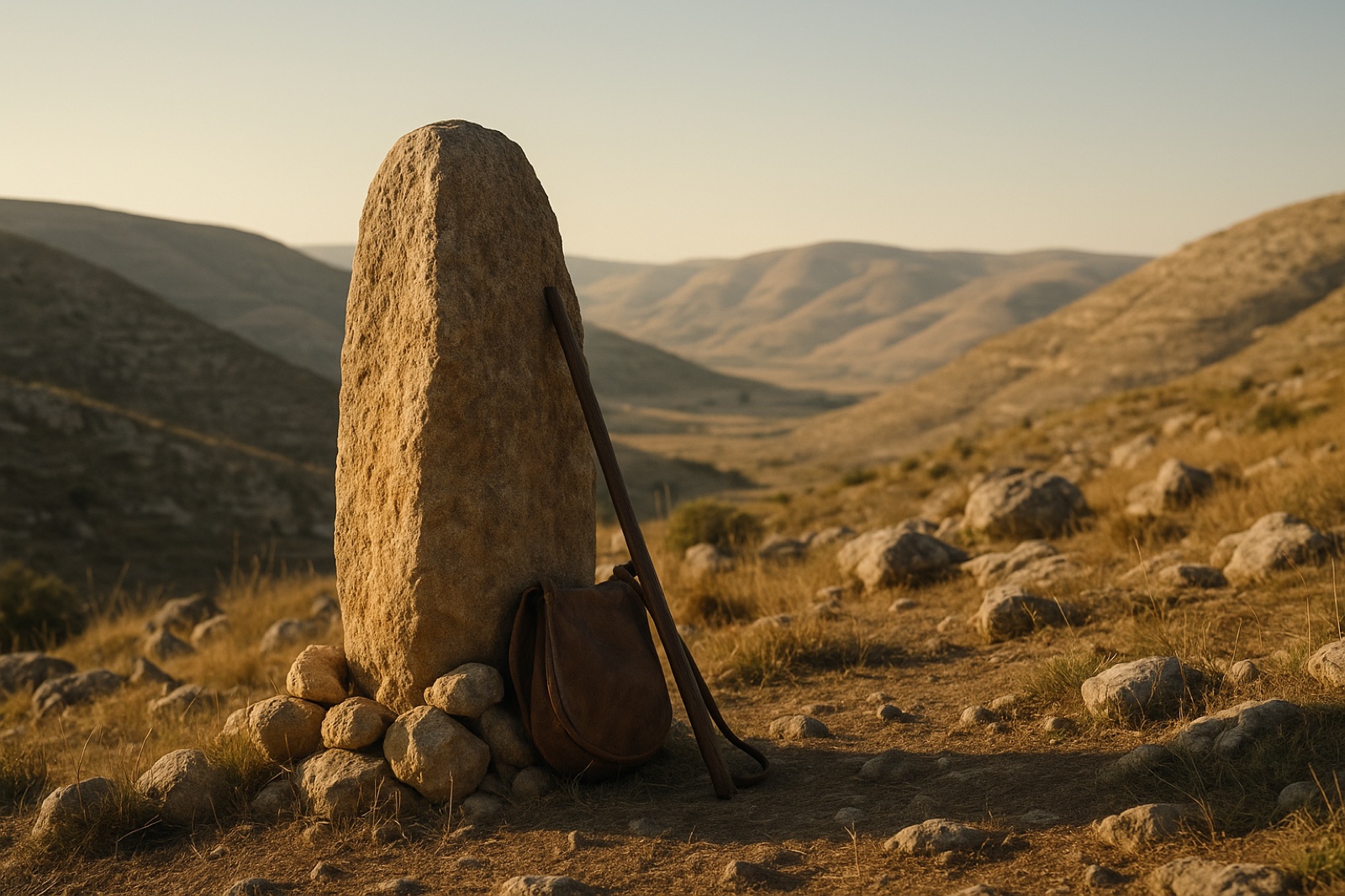
Ebenezer is two Hebrew words pressed together: eben, a stone, and ha-ezer, the help. Strong’s lists the name as H72, “stone of the help.” Our Short gets this exactly right, and it gets the verse right too. After a victory, “Samuel took a stone, and set it between Mizpeh and Shen, and called the name of it Eben-ezer, saying, Hitherto hath the LORD helped us” (1 Samuel 7:12).
The word ezer is worth a second look. It is not a small word for a little assistance. The Psalms use it for God: “My help cometh from the LORD, which made heaven and earth” (Psalm 121:2), and “Our help is in the name of the LORD, who made heaven and earth” (Psalm 124:8). Genesis 2:18 uses the same word for the partner God makes for Adam: “an help meet for him.” It is the help that comes from outside you when you cannot manage alone.
Then there is “hitherto.” The Hebrew is ad-hennah, and hennah usually points to a place: here, hither. So Samuel’s words carry both senses at once. Up to this moment. Up to this spot. A man standing on a hillside with a stone, saying: as far as here, we were helped. Not beyond. Nothing about next year.
The hymn writer Robert Robinson heard that in 1758. The second verse of “Come, Thou Fount of Every Blessing” opens, “Here I raise my Ebenezer; hither by thy help I’m come.” Some later hymnals swapped the line out, because the reference had become obscure to most singers. Which is a little sad, since Robinson had caught the “hither” hiding in the verse.
There is one honest complication. Scholars do not agree whether the Ebenezer of chapter 4 and the stone of chapter 7 are the same place. The battlefield sat near Aphek, and many archaeologists link it to a site called Izbet Sartah. Samuel’s stone stood near Mizpeh, in different hill country. Either chapter 4 uses the name the place would only earn later, or there were two Ebenezers and the second deliberately echoed the first. Both readings leave the reader in the same place: the name you meet first on a field of loss comes back as a name for help.
What Most People Miss: Twenty Years Between a Charm and a Stone
The Short had fifty seconds, so it jumped straight from the defeat to the stone. The chapters in between are where the meaning lives. Here is the sequence, in order:
- The plan. After the first defeat, the elders say, “Let us fetch the ark of the covenant of the LORD out of Shiloh unto us, that, when it cometh among us, it may save us out of the hand of our enemies” (1 Samuel 4:3). The Hebrew pronoun can be read as “it” or “he,” and translations split, but either way the strategy was to carry a sacred object onto the field.
- The collapse. “There fell of Israel thirty thousand footmen,” and “the ark of God was taken” (1 Samuel 4:10-11).
- A baby named for the loss. The wife of Phinehas, the priest’s son, goes into labour when she hears the news and names the child I-chabod, “saying, The glory is departed from Israel” (1 Samuel 4:21).
- The long wait. The ark comes back after seven months, then stays at Kirjath-jearim, “for it was twenty years: and all the house of Israel lamented after the LORD” (1 Samuel 7:2).
- Coming with empty hands. At Mizpeh the people pour out water, fast, and say, “We have sinned against the LORD” (1 Samuel 7:6). No ark is carried out this time. Samuel prays, and “the LORD thundered with a great thunder on that day upon the Philistines” (1 Samuel 7:10).
- The stone. Only after the help has come does Samuel set up Ebenezer.
Put chapter 4 next to chapter 7 and the difference is plain. The first time, Israel brought the holiest thing it owned and expected the thing to do the saving. The second time, they brought nothing except the truth about themselves. The stone came afterwards, and a stone cannot save anybody. It was not a charm to carry into the next battle. It was a receipt: proof that help had already been given, set where people would walk past it.
And look at the two names. One generation named a child after what was lost. Twenty years on, the name was for what had carried them. Both were honest. Only one was the end of the story.
That is why this matters on an ordinary Tuesday. Most of us are tempted to go looking for our own ark, the ritual or object or perfect routine we hope will guarantee things go well. An Ebenezer works the other way round. You do not raise it to make help come. You raise it because help already did. If you want a place to start noticing, our Bible verse for how I feel tool matches a verse to where you are today.
Actions to Take This Week
Pick up one small stone today and set it somewhere you will see it tomorrow morning, as a reminder of one specific time you were helped through, not as a charm for the next thing.
Write one sentence that begins “Hitherto” and names a hard season you have come through so far, and stop there without adding anything about what comes next.
Tell one person today about a time help came when you did not expect it, and say out loud where you believe it came from.
A Prayer for Remembering How Far God Has Helped Me
God, I remember my losses far more clearly than my rescues. I have given names to the hard days and forgotten the help that got me through them. Forgive me for the times I have reached for something to hold instead of reaching for you. I am not asking for a life with no hard days ahead. I am asking to see honestly that you have carried me this far. Hitherto you have helped me. Help me set that somewhere I can see it tomorrow. Amen.
Journal Prompts
What is the “Ichabod” in your story, the loss you have quietly named yourself after?
Where have you been hoping a routine, a habit or an object would guarantee a good outcome, the way Israel hoped the ark would?
If you set a stone at one point in the last five years and said “this far, I was helped,” where would you set it?
What would change if you let “hitherto” be enough, without needing a promise about the next hard thing?
Share This
An Ebenezer isn’t a lucky charm for the next battle. It’s a receipt for the help I already got. Hitherto hath the LORD helped us.
#Ebenezer #HebrewWords #BibleStudy #FaithEveryday #1Samuel
Q&A: What Does Ebenezer Mean? It Was a Rock Before It Was Scrooge
What does Ebenezer mean in the Bible?
Ebenezer means “stone of help,” from the Hebrew eben (stone) and ha-ezer (the help), listed in Strong’s as H72. In 1 Samuel 7:12 the prophet Samuel sets up a stone after a victory over the Philistines, names it Eben-ezer, and says, “Hitherto hath the LORD helped us.” It was a memorial of help already received.
What does “Here I raise my Ebenezer” mean?
“Here I raise my Ebenezer” is a line from the hymn “Come, Thou Fount of Every Blessing,” written by Robert Robinson in 1758. It refers to Samuel’s stone in 1 Samuel 7:12, so singing it means setting up a marker that God has helped you up to this point. The next line, “hither by thy help I’m come,” echoes the word “hitherto” in the original verse.
What does “hitherto hath the LORD helped us” mean?
The Hebrew behind “hitherto” is ad-hennah, meaning up to here or thus far, and hennah most often points to a place. Samuel was saying that God had helped Israel as far as that moment and that spot, which is why many modern translations read “Thus far the LORD has helped us.” It is a statement of gratitude for the past, not a promise that nothing hard will ever happen again.
Is the Ebenezer in 1 Samuel 4 the same as the one in 1 Samuel 7?
Scholars are divided. The battle in 1 Samuel 4:1, where Israel lost the ark, took place near Aphek and is often linked to the archaeological site of Izbet Sartah, while Samuel’s stone in 1 Samuel 7:12 stood between Mizpeh and Shen. The writer may be using the later name for the earlier place, or there may have been two sites with the same name.
What does the Hebrew word ezer mean?
Ezer means help, usually strong help that comes from outside someone who cannot manage alone. The Psalms use it of God: “My help cometh from the LORD, which made heaven and earth” (Psalm 121:2). Genesis 2:18 uses the same word when God makes “an help meet for him,” so the word carries no sense of being lesser.
Back Beside the Stone
The story starts with a crowd shouting so loudly the ground rang, around a box they believed would save them. It ends with one man, a plain stone, and a single quiet sentence about how far they had come.
Dickens gave the name to a miser in 1843, close to three thousand years after Samuel, and most people have met it only there. But it began as something you could put your hand on. Here, and this far, help came.
You have a place like that too, even if you have never marked it. Where would you set your stone? Tell us in the comments, and if someone you love is in the middle of their own long twenty years, send this to them.
Watch the original short: What Does Ebenezer Mean? It Was a Rock Before It Was Scrooge on YouTube.