 0
0
 0
0
Some questions you can ask out loud. This one you usually type into a search bar with the phone turned face down on the blanket, at an hour when nobody is awake to see you ask it.
What is the unforgivable sin? And underneath that question, almost always, sits a second one the search bar never sees: did I do it?
Here is something worth knowing before we go one line further. The passage everyone is afraid of does not leave you guessing at what it means. Mark wrote down the reason for it. One short sentence, sitting at the end of the scene like a note pinned to a door:
“Because they said, He hath an unclean spirit.” (Mark 3:30)
Most people have never read that line. They have read the warning. The warning travels well on its own — through sermons, through comment sections, through a memory of something a relative said years ago. The reason clause stays behind in the chapter, where almost nobody goes to look for it.
So let’s go get it.
What Is the Unforgivable Sin? Start With the Room It Was Said In
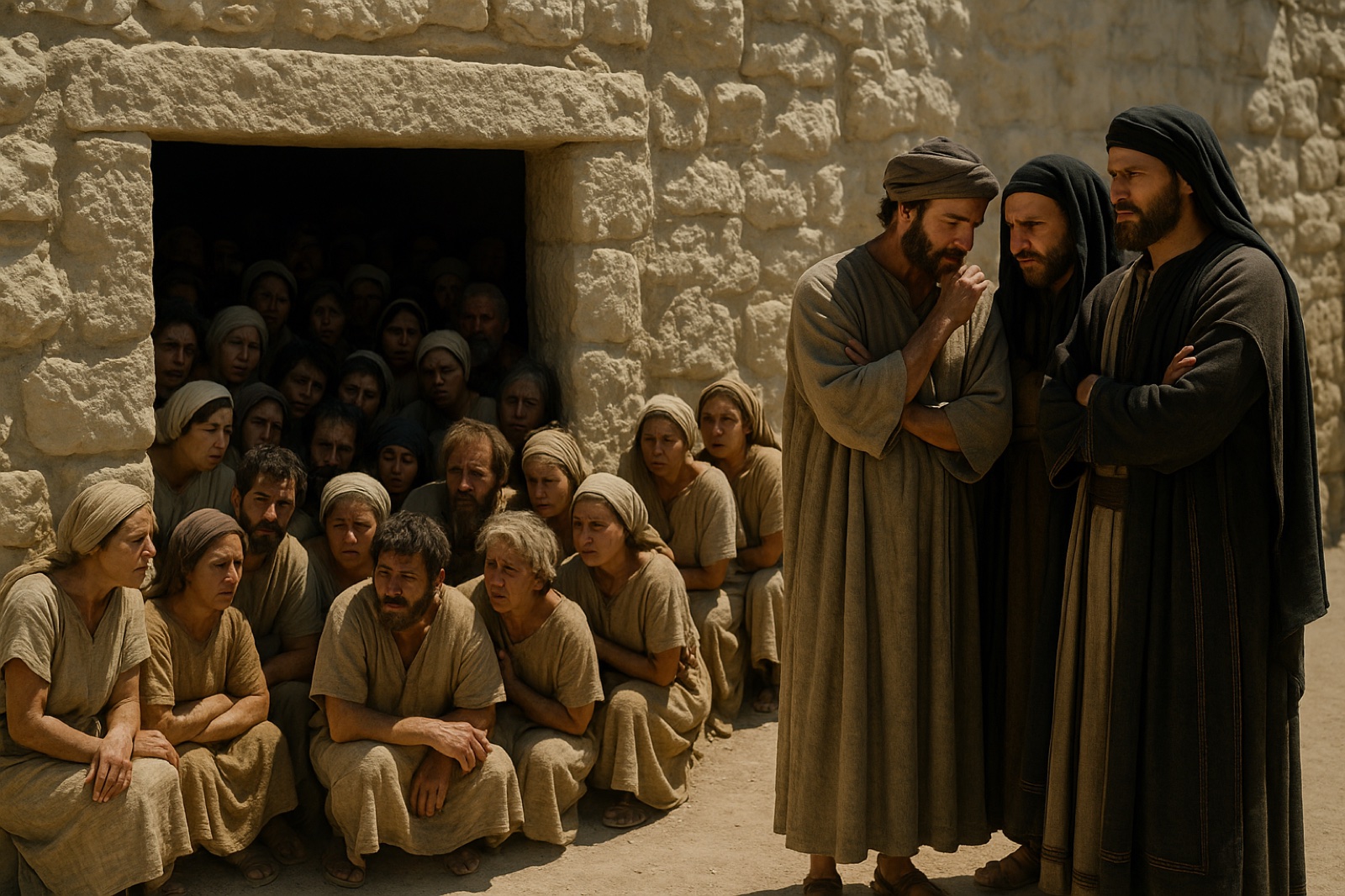
Mark 3 is not a quiet chapter. It opens with crowds so heavy that ordinary life stops working: “And the multitude cometh together again, so that they could not so much as eat bread.” (Mark 3:20) People are being healed. People are being freed. The house is full.
Into that room walk religious scholars who have travelled a long way to be there. Mark is careful to say where they came from: “And the scribes which came down from Jerusalem said, He hath Beelzebub, and by the prince of the devils casteth he out devils.” (Mark 3:22)
They are not passers-by. They came for this. They watched people get their lives back in front of them — and announced that the power doing it belonged to the enemy.
Jesus answers them with plain logic. “How can Satan cast out Satan?” (Mark 3:23) A kingdom split against itself cannot stand. A house split against itself cannot stand. Then comes the sentence everyone knows — but it does not start where people think it starts. It starts here:
“Verily I say unto you, All sins shall be forgiven unto the sons of men, and blasphemies wherewith soever they shall blaspheme: But he that shall blaspheme against the Holy Ghost hath never forgiveness, but is in danger of eternal damnation.” (Mark 3:28-29)
Read the first half again. Before any warning arrives, Jesus makes the widest statement about forgiveness in the whole chapter. All sins. And not only sins — blasphemies, of whatever kind, however they are spoken. That is the opening offer. The exception comes second, and it comes with a reason attached two verses later.
The Accusation One Verse Earlier That Almost Nobody Quotes
Here is the part that changed how I read this passage, and it is hiding in plain sight.
Back up one verse from the scribes. Before they ever open their mouths, somebody else has already said something false about Jesus:
“And when his friends heard of it, they went out to lay hold on him: for they said, He is beside himself.” (Mark 3:21)
His own people. The word the King James uses is “friends,” and the same chapter tells us who turns up at that house a few verses later: “There came then his brethren and his mother.” (Mark 3:31) These are the people closest to him in the world, and their considered opinion is that he has lost his mind. They are not whispering it. They have come to physically take hold of him and remove him from the situation.
So Mark has set two accusations one verse apart. Both are untrue. Both are said out loud, in public, about the same person, on the same day.
Only one of them gets the warning.
And Mark does not leave the family off-screen to be quietly forgotten. He brings them right back at the end of the scene, standing outside, asking for him. Jesus’ response is not a condemnation. It is one of the most generous redefinitions in the Gospels: “For whosoever shall do the will of God, the same is my brother, and my sister, and mother.” (Mark 3:35)
Whatever the unforgivable sin is, Mark has placed a near-miss directly beside it. Saying something wrong about Jesus — badly wrong, publicly wrong, wrong in a way that would humiliate him in front of a crowded house — is demonstrably not automatically it.
Luke Puts the Same Sentence Somewhere Completely Different
There is a second thing worth noticing, and it takes about thirty seconds to check.
Matthew keeps this saying close to the same confrontation (Matthew 12:31-32). Luke does not. Luke drops it into a completely different setting — a passage about ordinary people being dragged in front of authorities and made to answer for themselves:
“And whosoever shall speak a word against the Son of man, it shall be forgiven him: but unto him that blasphemeth against the Holy Ghost it shall not be forgiven.” (Luke 12:10)
Now read what comes in the very next breath:
“And when they bring you unto the synagogues, and unto magistrates, and powers, take ye no thought how or what thing ye shall answer, or what ye shall say: For the Holy Ghost shall teach you in the same hour what ye ought to say.” (Luke 12:11-12)
Look at who that is spoken to. People under real pressure. People frightened they will say the wrong thing at the worst possible moment. And the promise handed to them is that they will not be left to manage it alone — the words will be supplied.
Luke sets the hardest sentence in the Gospels directly against one of the gentlest promises in them. If this saying were designed as a trap for anxious people afraid of saying the wrong thing, that is an extraordinary place to file it.
The Difference Is Not the Size of the Words
So what actually separates verse 21 from verse 22? They are one line apart. Both are false. One passes without comment; one draws the only warning of its kind that Jesus ever gives.
It is not the severity of the sentence. “He is out of his mind” is not a small thing to say about someone.
It is the direction the speaker is facing.
His family said their wrong thing while walking toward him. They got it badly wrong, and they were still coming to get him, still claiming him, still in the story. Wrong about him — and moving in his direction.
The scribes said theirs from a distance, having travelled a long way with a conclusion already packed. They were not trying to reach him. They had reached a verdict.
That is exactly what Mark 3:30’s reason clause preserves for us. Not a slip of the tongue. Not a syllable. A settled position about what the good standing in front of them actually was — filed, closed, and not going to be reopened.
The scribes had reached a verdict. You are still asking a question.
A verdict like that is unforgivable the way a locked door is impassable. Not because no key exists. Because nobody inside is reaching for the handle.
Which means the very thing driving you to type this question at midnight is pointing the opposite way from the men in that room. They were not afraid they had offended God. They were building a case. You are asking a question you are frightened of the answer to — and a question is not a verdict. It is the sound of a door that is still moving.
If that particular fear is the thing that actually brought you here, we wrote a whole piece on it: the one thing that proves you haven’t committed the unforgivable sin. And if the passage that haunts you is not this one but the other famous hard one, Hebrews 6:4-6 has a next verse most people never read either.
Actions to Take
- Read Mark 3:20-35 in one sitting. It takes about two minutes. Do not start at verse 28 — start at verse 20, and watch specifically for verse 21. Reading the warning inside its own scene does more than reading any explanation of it, including this one.
- Say the actual sentence out loud to God. Not “forgive my sins” in general. The specific thing you are afraid of — the words, the season, the moment you keep replaying. Say it plainly. People who have hardened past reach do not do this. That is the point.
- Tell one person today. A message to a friend is enough. This fear survives almost entirely on being unspeakable; it gets noticeably smaller the first time somebody else hears it and does not flinch.
Journaling Prompts
- Picture the moment you are most afraid of. Which direction were you facing — arguing your way further from God, or trying to get to God and failing badly at it?
- Where did you first learn to be afraid of this passage? Not who to blame — just trace it back. What was said, and who was in the room?
- You have been carrying this question rather than putting it down. What has holding onto it been protecting you from having to do?
A Prayer
God, I have been afraid of this longer than I have admitted to anyone. I do not fully understand what those men in that house did, but I know I am not standing where they stood, because they were not afraid and I am. If the fact that I am still asking means the door is still open, then I am asking. Please meet me here, tonight, exactly as scared as I am.
Amen.
What Did You Think?
Why do you think this one warning travelled so much further than the sentence right in front of it — the one where Jesus says all sins and blasphemies are forgiven? Share your take in the comments; someone reading this at 2am needs to see it.
Share This
- “Mark 3:30 gives the reason for the unforgivable sin in one sentence. Almost nobody quotes it.”
- “One verse before the scribes accuse Jesus, his own family says he’s out of his mind. Only one of those gets the warning. The difference isn’t the words — it’s the direction they were facing.”
- “The scribes had reached a verdict. If you’re asking the question, you haven’t.”
Questions People Ask
What is the unforgivable sin in the Bible?
In Mark 3:28-29, Jesus says all sins and blasphemies can be forgiven, but blasphemy against the Holy Ghost has “never forgiveness.” Mark 3:30 supplies the reason clause directly: “Because they said, He hath an unclean spirit.” The people being warned were religious scholars who had travelled from Jerusalem, watched Jesus free people in front of them, and publicly credited that work to Satan. The warning is attached to that specific settled accusation, not to a stray thought or an angry outburst.
Did anyone else say something false about Jesus in the same chapter?
Yes, and this is the detail most readers miss. One verse earlier, in Mark 3:21, Jesus’ own friends and family say “He is beside himself” — that he has lost his mind — and go out to physically take hold of him. That accusation is false and public, and no warning is attached to it. At the end of the same scene, Mark 3:31-35, those relatives arrive at the house and Jesus responds by widening the definition of family rather than condemning them.
Does the unforgivable sin appear the same way in every Gospel?
No. Matthew 12:31-32 keeps the saying near the same Beelzebub confrontation. Luke 12:10 places it in a different setting entirely — a passage about believers being brought before synagogues, magistrates and powers. In Luke, the very next verses promise that the Holy Ghost will teach those people what to say in the moment they need it. The surrounding material in Luke is reassurance to frightened people, not a threat to them.
Can someone commit the unforgivable sin by accident or by thinking something?
Nothing in Mark 3 describes an accident or an intrusive thought. The scene describes trained observers who saw an outcome they could not deny and made a deliberate public claim about its source. Mark 3:28 explicitly opens by saying all sins and all blasphemies are forgivable before naming any exception, which is the opposite of a passage designed to catch people out on a technicality.
Why does this passage frighten so many people who have not done anything like it?
Because the warning circulates on its own, separated from both the verse before it and the reason after it. Mark 3:29 read alone is genuinely alarming. Mark 3:28 through 3:30 read together is a statement of very wide forgiveness, one named exception, and an explicit reason for that exception. The fear usually comes from the fragment, not the passage. You can work through questions like this one any time with the free Bible Answers assistant, which opens in ChatGPT.