 0
0
 0
0
A little girl opens a drawer in her father’s dresser and finds photographs. A long train. Thin, worn-out people standing in a field. Strangers.
Her father, Carrol Walsh, had been a sergeant in the US Army during the Second World War. The pictures had come from a fellow tank commander. And they sat there, in an ordinary drawer in an ordinary family home, a very long way from where they were taken.
This week, CBS News told the story behind those photos to a national audience. It is the story of a train near Magdeburg, Germany, about 2,500 people trapped inside it, and a group of young soldiers who stopped, helped, and moved on. For decades, most of them had no idea what became of the people they found.
It is also a story about a question most of us carry quietly: does the good I do actually go anywhere?
What Happened on the Train Near Magdeburg in April 1945
By April 1945, the war in Europe was nearly over. Nazi Germany was collapsing, and prisoners in the camps were being moved ahead of the advancing armies.
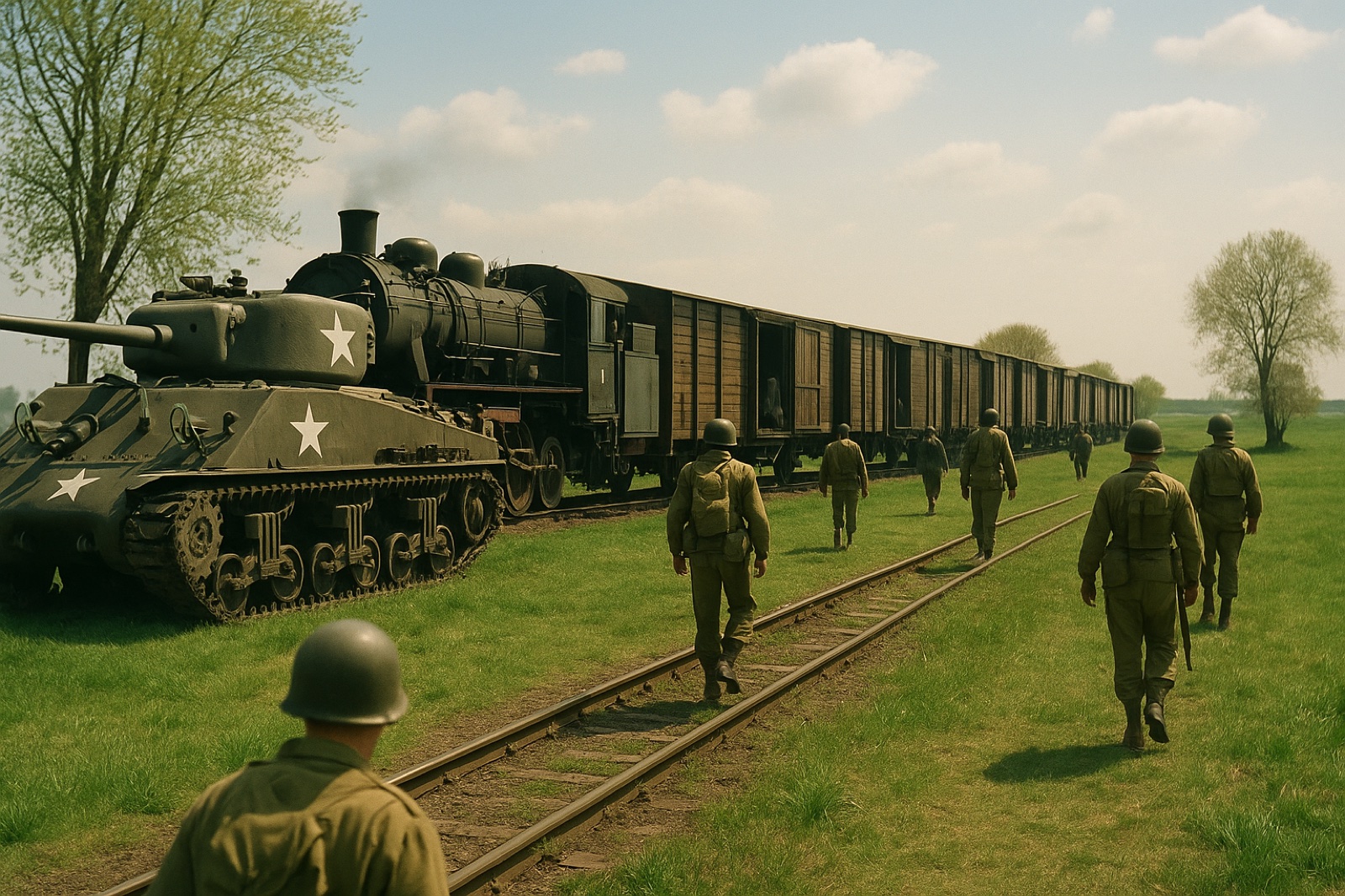
One of those camps was Bergen-Belsen. It was badly overcrowded, and typhus was spreading through it. About 2,500 Jewish prisoners from Bergen-Belsen were packed onto a train of cattle cars and passenger cars and sent toward another camp. Frank Towers, an American lieutenant who was there, later said the train was headed for Theresienstadt and had already been travelling for about six days.
On 13 April 1945, the train was standing still on the tracks near the village of Farsleben, outside Magdeburg. That is where soldiers from the US 743rd Tank Battalion and the 30th Infantry Division came across it.
Carrol Walsh remembered the day like this: “A beautiful April day. We were zooming like crazy through the middle of Germany. We came across this train, and it was full of Holocaust victims.”
Another tank commander, George Gross, described what he saw: “Every one of them looked like a skeleton.” But then something happened he didn’t expect. When the prisoners saw the soldiers, he said, they began laughing with joy, “if you can call it laughter. It was more of an outburst of pure, almost hysterical relief.”
Peter Lantos was five years old and on that train. He remembers the moment the way a small child would: “There was kind of a noise, and suddenly it became quiet. And then people started to shout, ‘Americans! Americans!'”
The soldiers were in the middle of a war, moving fast. As the teacher who later uncovered the story puts it: “They didn’t have to stop. They didn’t have to help these people. But they did.”
If you have ever wondered whether the ordinary moments of your life mean more than they seem to, this free video guide was made for that question.
How a School Project Found the People in the Photos
In 2001, Matthew Rozell was a history teacher in Hudson Falls, a small town in New York. He was running an oral-history project with his students, recording the memories of Second World War veterans while they were still alive to share them. One of the men he interviewed was Carrol Walsh.
Walsh talked about the train. George Gross had also taken photographs that day, and Rozell started putting the pictures and the memories together.
Then he did something very simple. He put the interviews online.
And people wrote back. Over the years, Rozell heard from dozens of survivors of the train and the soldiers who had found it. Beginning in 2007, he started bringing them together, liberators and survivors in the same room, with his students there too. His book, A Train Near Magdeburg, gathers the stories of 15 American liberators and more than 30 survivors, and a documentary with the same name is on the way.
Frank Towers went looking as well. He posted an appeal on a veterans’ website, asking anyone who had been on the train to get in touch. The first reply came from a woman in Australia. After that, he said, “the whole thing snowballed.”
The Rescuers Were Scared, Too
It would be easy to tell this as a story about fearless heroes. The men who were there didn’t tell it that way.
Towers was honest about what it was like when the doors opened. The smell, he said, was “not to be believed.” The people inside wanted to hold on to their rescuers. “They wanted to hug us,” he said, “but we didn’t want them to touch us because we didn’t know what disease they were carrying.”
That fear wasn’t foolish. Typhus had come with the prisoners from Bergen-Belsen, and some people had already died on the train.
And still, they helped. The soldiers rounded up around 50 trucks, ambulances and other vehicles to move the survivors away from the fighting. They ordered local mayors to find housing, food and medical care. Nearby buildings were turned into makeshift hospitals.
Towers summed it up in words that feel almost too plain for what happened: “We were trained to fight a war. We weren’t trained to be humanitarians. But these people were dumped in our laps and we couldn’t just leave them.”
That may be the most important part of the whole story. Not courage without fear. Kindness done while afraid, by people who weren’t sure they were the right ones for the job.
More Than 400 Descendants
The children on that train grew up. According to news reports on the reunions, survivors went on to become surgeons, engineers, lawyers, teachers and business owners. Peter Lantos became a neuroscientist and an author. Another survivor, Micha Tomkiewicz, became a physics professor in New York.
In May 2011, a reunion in Rehovot, Israel, brought together 50 people who had been on the train, along with more than 400 of their descendants. The survivors paid for Frank Towers and his son to travel there.
Sit with that for a second. One afternoon beside a railway line in Germany. And decades later, just the survivors who could be found for that one gathering had more than 400 children, grandchildren and descendants with them. Not one of those 400 people was alive yet when the soldiers climbed down from their tanks.
The Part of the Story That Is Still Missing
Here is the detail that is easy to read past. When Towers went searching, he found 235 people from the train, out of roughly 700 he believed might still be living at the time.
So even with a teacher, a website, a book and years of patient work, most of the story was never recovered. Many of the soldiers never learned the names of the people they helped. Many of the survivors never learned the names of the men who stopped. Carrol Walsh put it this way: “I cannot believe, today, that the world almost ignored those people.”
And that is where this old story meets a very ordinary one. Yours.
Does the Good You Do Actually Matter?
Most of the good we do for other people, we never see the end of. You help a stranger with a heavy bag. You stay on the phone with a friend longer than you planned. You give someone a second chance. Then life moves on, and you never find out what it meant.
It can make kindness feel small. Sometimes even pointless.
The soldiers at Farsleben are a quiet answer to that. They didn’t stop because they knew how it would turn out. They couldn’t have known. Most of them went back to the war and then home to their lives. The good they did was already real, long before anyone came looking for them to say thank you.
It works the way a lot of lasting things do. A surgery named after a pitcher who died at 83 is still saving careers of athletes who never met him. What we set in motion keeps going after we stop watching.
There is a piece of very old wisdom, older than any of these men and treasured by Jews and Christians alike, that says it simply: cast your bread upon the waters, and after many days you will find it again. It doesn’t promise that you will be the one who sees where it lands. It only says it isn’t lost. Some people call that history. Others believe God keeps the record the rest of us can’t read.
What to Take From a Story Like This
You probably won’t come across a train this week. But you will likely meet someone who needs you to stop for a minute. Maybe when you’re busy. Maybe when you’re a little afraid. Maybe when you’re not sure you’re the right person.
The soldiers weren’t sure either. They stopped anyway.
Peter Lantos, now among the last survivors, says telling these stories is “a moral obligation.” Perhaps the least the rest of us can do is keep telling them, and keep noticing the people right in front of us.
And if you have been wondering what your own life is really for, our free What Is My Purpose? assessment takes just a few minutes.
Questions People Ask About the Train Near Magdeburg
What was the train near Magdeburg?
The train near Magdeburg was a Nazi transport carrying about 2,500 Jewish prisoners from the Bergen-Belsen concentration camp in April 1945. It was found stopped on the tracks near the village of Farsleben, outside Magdeburg, Germany, on 13 April 1945, and the prisoners on board were freed by American soldiers.
Who liberated the Holocaust train at Farsleben?
The train at Farsleben was liberated on 13 April 1945 by American soldiers from the US Army’s 743rd Tank Battalion and the 30th Infantry Division. Men who were there included Sergeant Carrol Walsh, tank commander George Gross and Lieutenant Frank Towers, who later helped reunite survivors with their liberators.
How was the story of the Farsleben train rediscovered?
The Farsleben train story was brought back to light by Matthew Rozell, a history teacher in Hudson Falls, New York. In 2001 he interviewed veteran Carrol Walsh for a class oral-history project. After Rozell posted the interviews online, survivors and liberators contacted him, which led to reunions beginning in 2007 and his book, A Train Near Magdeburg.
What happened to the survivors of the train near Magdeburg?
After their liberation in April 1945, survivors of the train near Magdeburg were moved by American soldiers to temporary housing and makeshift hospitals, as many were sick with typhus. Many went on to build lives around the world as surgeons, engineers, teachers, scientists and business owners. At a 2011 reunion in Rehovot, Israel, 50 survivors gathered with more than 400 of their descendants.
Let’s Talk
Does an act of kindness still matter if you never find out what it did? Share your answer in the comments. We’d love to hear what you think.
Share This
Post 1:
In April 1945, US soldiers found a train near Magdeburg with about 2,500 Holocaust prisoners inside. For decades most of them never knew who they saved. Then a teacher’s class project found them. https://bgodinspired.com/?p=115458
Post 2:
“We weren’t trained to be humanitarians. But these people were dumped in our laps and we couldn’t just leave them.” The soldiers who freed a Holocaust train were scared too. They helped anyway. https://bgodinspired.com/?p=115458
Post 3:
50 survivors of one train. More than 400 descendants at their reunion. None of those 400 were born yet on the afternoon the soldiers stopped. Kindness goes further than we ever get to see. https://bgodinspired.com/?p=115458