 0
0
 0
0
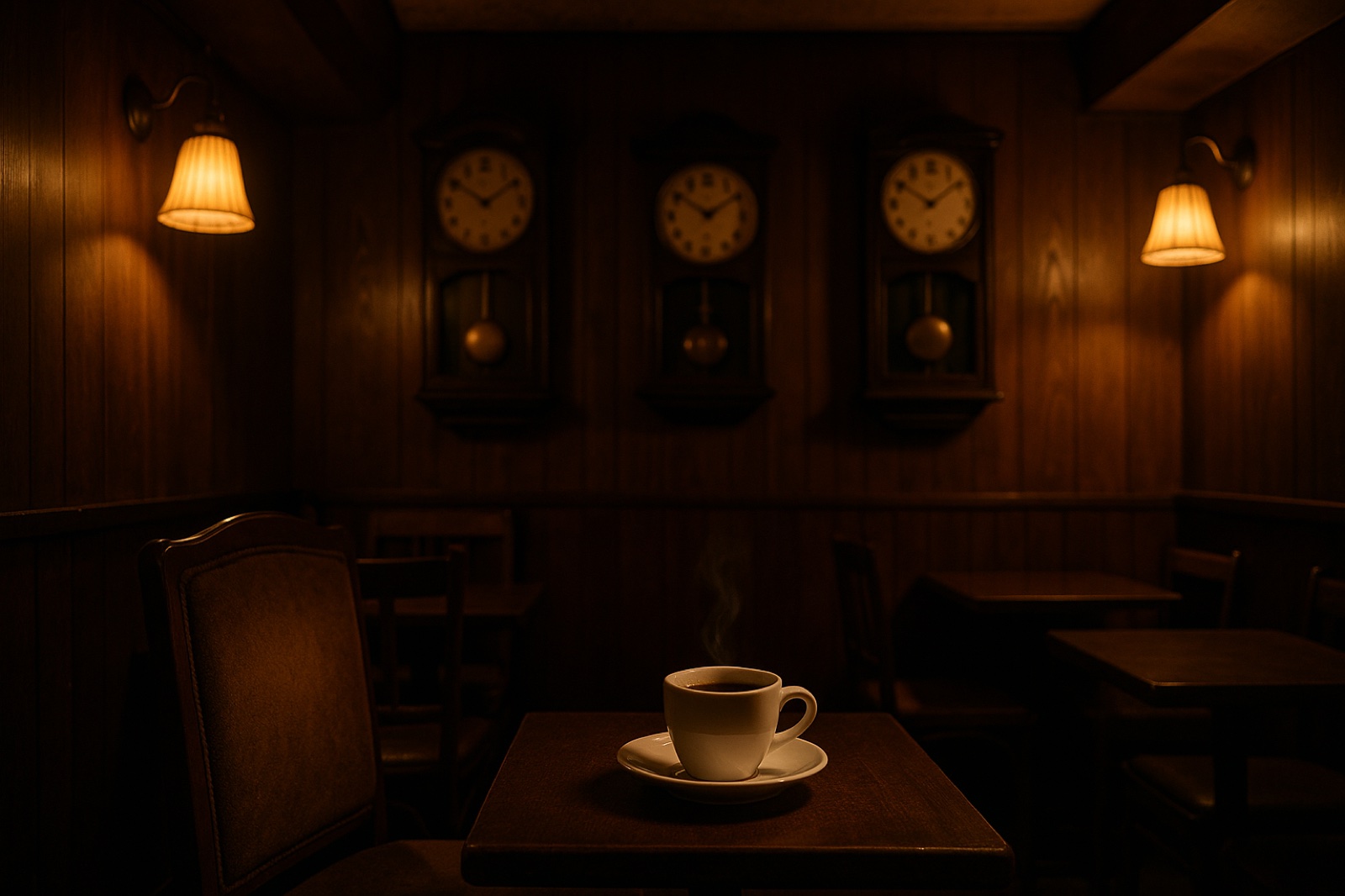
There is a café down a flight of stairs in a Tokyo back alley. It has no windows. The lamps turn the walls the colour of old photographs. Three big antique clocks hang on the wall, and they do not agree about the time.
In one chair sits a pale woman in a white dress, reading a novel. She does not talk. She does not leave. Once a day she gets up to go to the bathroom, and for those few minutes her chair is empty. That chair is the only way to travel through time.
If you came looking for the Before the Coffee Gets Cold meaning, start with that chair. Most people remember the book as a gentle story about time travel. But look closely at what that chair actually lets you do. The answer is almost nothing. And that is the whole point of the book.
What Before the Coffee Gets Cold is really about
Before the Coffee Gets Cold is a novel by the Japanese playwright and author Toshikazu Kawaguchi. It began as a stage play in 2010. The novel was published in Japan in 2015 as Kōhī ga Samenai Uchi ni, and in English in 2019 in a translation by Geoffrey Trousselot. It became a long-running bestseller in Japan and then far beyond it, and it is the first book in a series set in the same café.
The café is called Funiculi Funicula. It is run by Nagare Tokita, a big, quiet man, and his wife Kei. Nagare’s cousin Kazu works there too, and Kazu is the one who pours the coffee that sends people back.
The book is four stories. Four people sit in the chair. On the surface it is a time-travel novel. Underneath, it is a book about the sentence you did not say in time, and what it takes to finally say it.
A time machine built to be useless
Most time-travel stories give you power. This one takes power away, one rule at a time. Kazu explains them, and with each one the time machine gets a little less exciting.
You can only meet people who have been to the café. You have to sit in that one chair, and only when the woman in the white dress has left it. Once you are back in time, you cannot get up. Nothing you do in the past will change the present. And you have to finish your coffee before it gets cold. If you don’t, you never come back. You become the next ghost in the chair.
Read that list again and notice what it does. It removes every normal reason to time travel. You can’t stop the accident. You can’t win the argument. You can’t warn anyone, fix anything, or go anywhere. You get a chair, a cup, and a conversation with someone who once walked down the same stairs as you.
Plenty of people have heard the legend, come to try it, heard the rules and gone home. So the real question of the novel is not how the time travel works. It is: with rules like these, why would anyone go?
Four people, four sentences
Fumiko Kiyokawa goes first. She is a sharp, successful woman whose boyfriend, Goro, told her he was moving to America for work. That conversation went badly, and she never said what she actually meant. She goes back to that day. She knows it won’t bring him home. It doesn’t. What she gets is the conversation they should have had, and it turns out Goro had things he never said either. When she comes back, nothing has changed. Kazu tells her, more or less, that what happens next is up to her.
The second story is the hardest. Fusagi, a regular, has early-onset Alzheimer’s. He carries a letter meant for his wife, but he no longer recognises her. His wife, Kohtake, is a nurse, and she has quietly turned herself into his nurse at home, too. She goes back to a day when he still knew her, to receive the letter from the man who wrote it. In it, he asks for one thing. He does not want to be her patient. He wants them to stay husband and wife. She comes back to the same illness, the same man who doesn’t know her name. What changes is her. She stops nursing him and goes back to loving him.
Then Hirai. She owns a small bar and left her family’s inn in Sendai years ago. Her younger sister Kumi stayed and ran it. Kumi keeps coming to Tokyo to see her, and Hirai keeps hiding, sure her sister has come to lecture her about coming home. Then Kumi dies in a car accident on the way back. Hirai is so desperate that she tries to drag the ghost out of the chair and gets cursed for it. When she finally does go back, she learns that Kumi never wanted to guilt her. Kumi wanted them to run the inn together.
The last story belongs to Kei, the owner’s wife. She was born with a weak heart, and she is pregnant. The doctors have told her what the birth might cost. She is the only one of the four who goes forward instead of back. She arrives further ahead than she meant to, and she meets her daughter. Readers find out that a schoolgirl who turned up in the café earlier in the book, and asked to take a photo with Kei, was that same daughter, Miki, visiting from the future.
Put the four side by side and you see the pattern. Nobody goes back to change what happened. Everybody goes back to hear something, or say something, that got stuck. It is the same idea we followed in another Japanese novel about the past, Kafka on the Shore, where the thing that sets a person free is not solving the mystery. Here, too, the facts stay exactly where they were.
Count the endings
Here is the thing that is easy to miss. The café’s big rule is that the present will not change. Now count how many presents change by the last page.
Fumiko walks out with a reason to wait for Goro instead of a reason to forget him. Kohtake stops being a nurse and starts being a wife again. Hirai goes home to Sendai to run the inn her sister wanted to share with her. Kei decides to bring her daughter into the world.
That is four out of four. The rule is never broken, and the present changes every single time. The café does not change anything. The people change it, after they come back up the stairs.
And there is one person in the book the café itself really did change for good. It is the woman in the white dress. The book tells us she went back to see her husband, who had died, and stayed too long. She is the only traveller in the book who did not come back. So she is the only one for whom everything stopped. She sits in the chair, reading, never getting any further.
That is why the cold coffee matters so much. It is not a cute rule. It is the book’s quiet warning. The past is a place you can visit. It is not a place you can live. Stay too long and you do not fix it. You just stop.
So the book’s answer to “why would anyone go?” is not that the past needed fixing. The past was never the thing that was broken. The person in the chair was stuck. They went back to get unstuck, and then they had to drink the coffee and leave.
Turning, not undoing
There is a very old word for what that café actually offers, and most people have it wrong.
The word is usually translated “repent”, and people hear it as “feel really sorry”. But the word used in the Gospels, metanoia, means a change of mind. A turning around. It has never promised to undo anything. It can’t. What it changes is the person, and which way they are facing. We wrote more about that in what repent really means in the Bible, and it is not about how sorry you are.
Jesus told a story about exactly this. A younger son takes his inheritance, wastes all of it, and ends up hungry in a field feeding pigs. The money is gone. That part is never undone. But the story says that one day “he came to himself”. Something turns inside him before he takes a single step. Then he gets up and walks home, and his father runs to meet him on the road.
That is the café’s whole logic, told two thousand years earlier. The past stays where it is. The change happens in the person. And the turning only counts once you get up and go home. Hirai does it almost literally. She comes back from three days ago and decides to go home and run the family inn.
Kawaguchi’s book never mentions any of this, and it doesn’t need to. But it understands something that a lot of people who use the word “repent” have forgotten. Nobody gets to rewrite what happened. Everybody gets to turn around.
Why the coffee has to go cold
It would have been easy to write a book where the café gives people a second chance at the past. That book would have been more exciting and much less true. Kawaguchi wrote the harder one. His café gives you a cup of coffee and a few minutes, and then it sends you back to the life you already have.
That is why the book stays with readers. Almost everyone has a Goro, a Kumi, a letter they never got to read. Nobody reading it has a magic chair. But the book quietly suggests you never needed one. The four customers didn’t really need the past. They needed to say the thing, hear the thing, and then drink the coffee while it was still warm and walk back up the stairs.
And in the corner, the woman in the white dress turns another page.
Questions people ask about Before the Coffee Gets Cold
What is Before the Coffee Gets Cold about?
Before the Coffee Gets Cold is a novel by Toshikazu Kawaguchi, first published in Japan in 2015 and translated into English by Geoffrey Trousselot in 2019. It is set in Funiculi Funicula, a small basement café in Tokyo where a customer can travel back in time by sitting in one particular chair. It tells four linked stories: Fumiko and her boyfriend Goro, a nurse named Kohtake and her husband Fusagi, who has early-onset Alzheimer’s, Hirai and her younger sister Kumi, and the café owner’s wife Kei and her unborn daughter. It is less about time travel than about the words people failed to say in time.
What are the rules in Before the Coffee Gets Cold?
In Before the Coffee Gets Cold, time travel at the Funiculi Funicula café has strict rules. You can only meet people who have visited the café. Nothing you do in the past will change the present. You must sit in one specific chair, which is usually occupied by a ghost, a woman in a white dress, and you can only take it when she leaves. You cannot leave the chair while you are in the past. And you must drink your coffee before it gets cold, or you will become the ghost in the chair yourself.
Who is the woman in the white dress in Before the Coffee Gets Cold?
The woman in the white dress in Before the Coffee Gets Cold is a ghost who sits in the café’s time-travel chair, silently reading a novel. The novel explains that she went back in time to see her husband, who had died, and stayed too long, so her coffee went cold and she became trapped. She leaves the chair once a day to use the bathroom, which is the only time anyone else can travel. Later books in Toshikazu Kawaguchi’s series tell more of her story.
Why do people time travel in Before the Coffee Gets Cold if nothing changes?
In Before the Coffee Gets Cold, the rule that the present cannot change makes time travel seem pointless, and that is deliberate. The characters go back not to change events but to say or hear something they missed: Fumiko finally hears what Goro felt, Kohtake receives her husband’s letter, and Hirai learns what her sister Kumi really wanted. The past stays the same, but each traveller comes back changed, and then changes their own present through what they choose to do next.
What does the ending of Before the Coffee Gets Cold mean?
Before the Coffee Gets Cold ends with Kei, the café owner’s wife, who has a weak heart and is pregnant despite the danger. She travels into the future instead of the past and meets her daughter, Miki, and readers learn that a schoolgirl who visited the café earlier was Miki all along. The ending shows the book’s central idea from the other direction: the past cannot be changed, but what a person decides now shapes what comes next.
Your turn
Which of the four stories stayed with you the longest? I keep coming back to Kohtake and the letter, but a lot of readers say Hirai’s is the one that wrecked them. And if you could sit in that chair once, would you go back or forward? Tell me in the comments.
If you want to share this
The rule in Before the Coffee Gets Cold is that the present never changes. By the last page, all four customers’ presents have changed. The café didn’t do it. They did, after they came back.
The only person the café in Before the Coffee Gets Cold changes for good is the ghost in the white dress, the one who stayed in the past too long. The cold coffee isn’t a cute rule. It’s the warning.
Nobody in Before the Coffee Gets Cold goes back to fix the past. They go back to say the sentence they didn’t say in time. Then they have to drink the coffee and go home.