 0
0
 0
0
Somebody sets a plate down in front of you, and there is a question sitting on it.
Maybe you grew up in a home where certain meat never came through the door. Maybe you married into one. Maybe you simply read Leviticus for the first time and stopped short. So you go looking for what does the Bible say about eating pork — and the answers come back quick and tidy and finished in about two sentences. The law said no. Jesus fulfilled the law. You are free. Next question.
That answer is not wrong, exactly. It is just so short that it walks straight past the strangest chapter in the New Testament.
Because the Bible does answer this question. It just refuses to answer it as a food question.
What Does the Bible Say About Eating Pork in the Old Testament?
The law itself is not vague. It is almost blunt.
“And the swine, though he divide the hoof, and be clovenfooted, yet he cheweth not the cud; he is unclean to you. Of their flesh shall ye not eat, and their carcase shall ye not touch; they are unclean to you.” — Leviticus 11:7-8
Notice the reasoning, because it is odd. Israel was given a two-part test for land animals: split hoof, and chews the cud. The pig passes the first half and fails the second. It is not excluded for being dirty or dangerous. It is excluded for being a near miss.
And here is the part worth sitting with: Leviticus never says why. Not once. People have offered explanations for centuries — hygiene, distinctiveness from neighbouring nations, links to pagan sacrifice — and some are more persuasive than others. But the text gives no reason. It gives a boundary.
That matters for what comes next. If you do not know why a fence was put up, you cannot work out on your own when it comes down. Somebody has to tell you.
Peter Refused God Three Times — Over Lunch
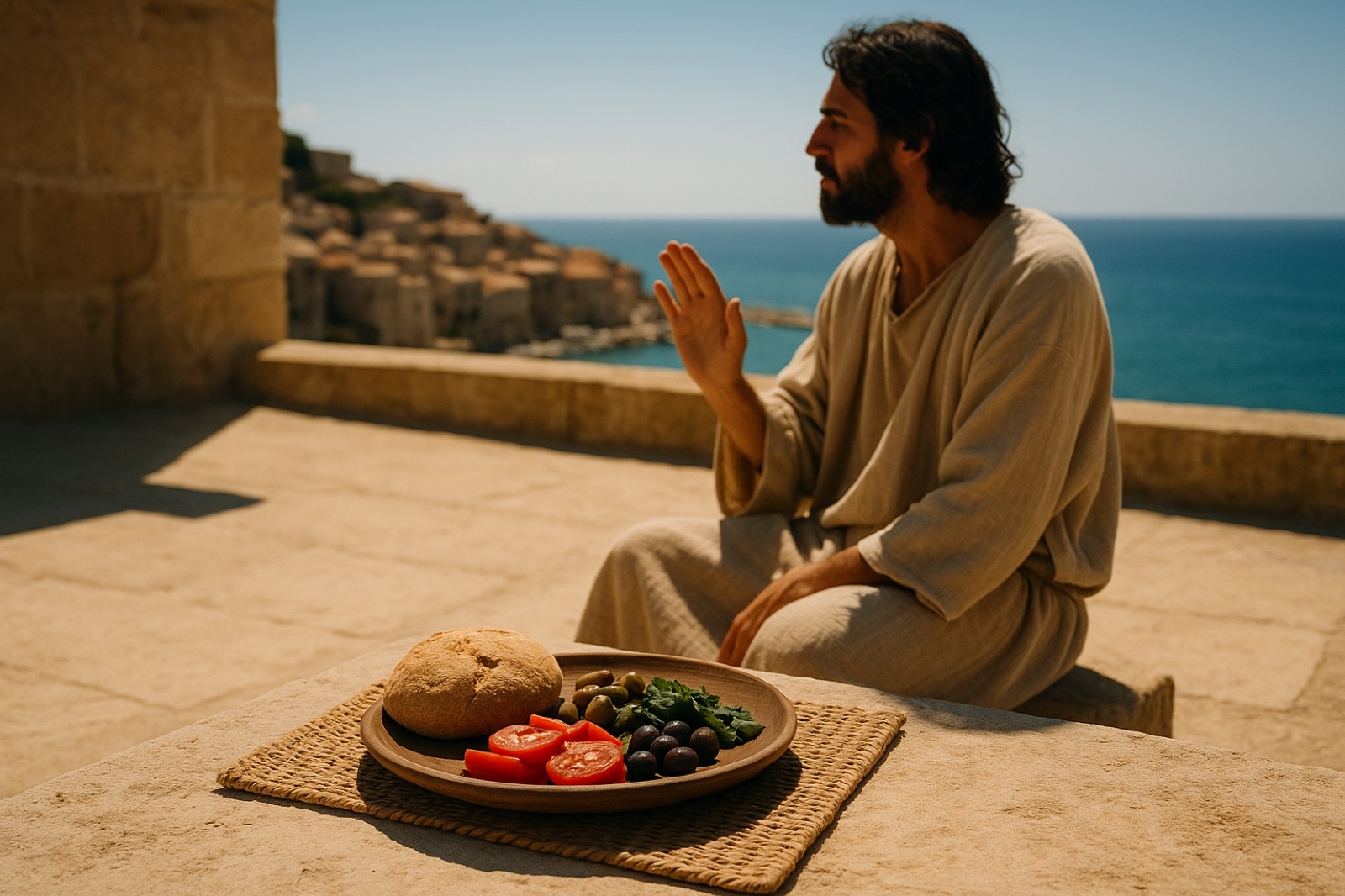
Years after the resurrection, Peter goes up on a flat rooftop around midday to pray. He is hungry. Food is being prepared downstairs. And while he waits, he sees something.
A great sheet comes down from heaven, full of every kind of animal — including all the ones he has avoided his entire life.
“And there came a voice to him, Rise, Peter; kill, and eat. But Peter said, Not so, Lord; for I have never eaten any thing that is common or unclean. And the voice spake unto him again the second time, What God hath cleansed, that call not thou common. This was done thrice: and the vessel was received up again into heaven.” — Acts 10:13-16
Read that again slowly, because it is easy to skim past what actually happens here.
Peter says no to God. Out loud. “Not so, Lord” — which is very nearly a sentence that cannot exist. And he does not do it once in a panic. The sheet comes down three times, and three times he holds his ground.
This is not a man being stubborn for the sake of it. This is a man who has spent every day of his life inside a boundary he was taught was holy, being asked to step over it with no explanation attached.
The Verse Everyone Quotes, and What It Actually Says
Before we get to what the vision meant, there is a detour most articles take at high speed, and it deserves more care than it usually gets.
The verse people reach for is Mark 7:19. In many modern translations it ends with a comment from the Gospel writer along the lines of “thus he declared all foods clean” — and that reading is taken by a great many careful scholars. But here is the same verse in the King James:
“Because it entereth not into his heart, but into the belly, and goeth out into the draught, purging all meats?” — Mark 7:19
No declaration. In the KJV the phrase describes what digestion does, not what Jesus announced. The difference between the two readings hangs on how one Greek participle is understood — whether it attaches to the food or to Jesus.
This is not an argument for one translation over another, and it is not a reason to distrust your Bible. It is a reason to notice something: the verse most often used to close this case is doing quieter work than the confident summaries suggest. Which is worth knowing before you build much on it.
Because the clear answer is not hiding in a participle. It is two chapters into Acts, and Peter says it himself.
Peter Told Us What the Vision Meant — and It Was Not Food
Here is the detail that reframes the whole chapter, and almost nobody quotes it.
“Now while Peter doubted in himself what this vision which he had seen should mean, behold, the men which were sent from Cornelius had made enquiry for Simon’s house, and stood before the gate” — Acts 10:17
Peter did not walk away from that rooftop with a food ruling. Luke says plainly that he did not know what it meant. He was still turning it over when the knock came.
Three men were downstairs at the gate. They had been sent by a Roman officer named Cornelius — a foreigner, an outsider, exactly the sort of person Peter had been raised to keep a careful distance from. And when Peter finally gets to the man’s house and has to explain why on earth he came, he tells us in one sentence what the sheet full of animals had been about:
“Ye know how that it is an unlawful thing for a man that is a Jew to keep company, or come unto one of another nation; but God hath shewed me that I should not call any man common or unclean.” — Acts 10:28
Any man. Not any meat.
The vision used the vocabulary Peter already had — clean and unclean, the categories he had sorted the world with since childhood — and then applied them somewhere he had never once thought to apply them. To people.
The Answer Arrived as a Person, Not a Ruling
This is the part that changes how the chapter reads.
God did not send Peter a clarified list. There is no revised food code anywhere in Acts 10. What arrived, while Peter was still puzzling on the roof, was a household of people standing at a gate — and the interpretation of the vision walked up and knocked on the door.
Then Peter says the line the whole chapter has been building toward:
“Of a truth I perceive that God is no respecter of persons: But in every nation he that feareth him, and worketh righteousness, is accepted with him.” — Acts 10:34-35
And there is one more piece of evidence that this was never a dietary story, sitting in the very next chapter. When Peter got back to Jerusalem, he was confronted. But look closely at what he was actually accused of:
“Thou wentest in to men uncircumcised, and didst eat with them.” — Acts 11:3
Nobody said a word about what was on the plate. The complaint was about who was at the table.
Everyone in that room understood immediately what the real question was — and it was never dinner. It was doors. Who is allowed in, and on whose say-so.
If you came to this page asking whether you can eat pork, the honest answer is that the Bible knocked down a far bigger wall than the one you were asking about, and left the small one lying underneath it.
What This Means for Your Table This Week
Two things follow from this, and the second one is uncomfortable.
The first is that this cannot become a way of ranking people. Paul saw that danger immediately and shut it down in a single verse:
“Let not him that eateth despise him that eateth not; and let not him which eateth not judge him that eateth: for God hath received him.” — Romans 14:3
Read who that protects. If you avoid pork — by conviction, by conscience, by how you were raised — that verse defends you from being looked down on. If you eat freely, the same verse defends the other person from you. It cuts both directions on purpose, and it settles the argument by refusing to settle it. This is the same instinct behind what the Bible actually says about tattoos, where one Old Testament line has been stretched into a rule it was never carrying.
The second thing is harder. Peter did not learn this permanently.
Years later, in Antioch, he was eating with Gentile believers until a group arrived from Jerusalem — and then, Paul writes, “he withdrew and separated himself, fearing them which were of the circumcision” (Galatians 2:12). The man who saw the sheet come down three times still slid back to the old side of the room when the pressure came.
Which is oddly encouraging. If Peter needed this lesson twice, the rest of us are not failing when it does not hold the first time. It is not a fact you learn. It is a door you have to keep choosing to leave open.
And if you are wondering whether you are on the wrong side of that door yourself — whether God is even listening to someone who has not sorted out what they believe yet — Cornelius is the answer, and that question gets its own honest look here. He was praying long before anyone told him he was allowed to.
If you want to press on another “what does the Bible say about” question you have carried for years, our free Bible Answers assistant is a good place to start — it opens in ChatGPT, and it will not be offended by the question.
Three Things You Can Do Today
- Read Acts 10:9-17. It takes about three minutes. Stop at verse 17 and notice that Peter still does not understand the vision — and that the men are already at the gate while he is working on it.
- Write down one name. The person you would find hardest to share a meal with. Not an enemy necessarily — just the one your mind quietly files under “not for me.” Nowhere anyone will see it.
- Send that person one ordinary message today. Not an apology. Not an invitation to sort anything out. Just contact — a question, a greeting, a “thought of you.” Opening a door does not require understanding first. Peter proved that.
Journaling Prompts
- Peter said “Not so, Lord” three times, out loud, to God. Where are you saying something like that quietly, without ever putting it into words?
- Who taught you where the line runs between the people who belong and the people who do not — and when did you last check whether that line was actually yours?
- The men were already at the gate while Peter was still puzzling on the roof. What might already be standing at yours, waiting for you to finish understanding it?
A Prayer You Can Pray Right Now
God, I did not expect a question about food to turn into a question about me. Show me the gates I have been guarding without even noticing I was guarding them — the people I quietly filed away as not for me. I do not want to be someone who argues three times before finally hearing it. Give me the nerve to open a door before I fully understand why it should be open. And thank You that when someone was standing outside the line, You were already on the way to them.
One Question for You
Why do you think we find rules about food so much easier to argue about than rules about people? Tell us what you think in the comments — we read every one.
Share This
- Peter said “Not so, Lord” three times over a plate of food. While he was still working out what the vision meant, the actual answer was standing at his gate. Acts 10 was never about dinner.
- When Peter got back to Jerusalem, nobody accused him of eating the wrong thing. The complaint was “thou wentest in to men uncircumcised, and didst eat with them.” The scandal was the company, not the menu.
- I went looking for what the Bible says about eating pork and found a chapter about who gets let in.
Questions People Ask About What the Bible Says About Eating Pork
What does the Bible say about eating pork?
Leviticus 11:7-8 lists the pig as unclean for Israel, because it divides the hoof but does not chew the cud, and instructs that its flesh is not to be eaten. Leviticus gives no reason for the rule beyond the classification itself. In the New Testament, Acts 10 records a vision given to Peter in which unclean animals are declared cleansed, and Romans 14:3 instructs believers on both sides of the question not to judge or despise one another over food.
Can Christians eat pork?
The New Testament treats this as a matter of conscience rather than a command. Romans 14:3 states: “Let not him that eateth despise him that eateth not; and let not him which eateth not judge him that eateth: for God hath received him.” That verse protects both practices deliberately — the believer who eats freely and the believer who abstains — and refuses to rank one above the other.
What was Peter’s vision in Acts 10 about?
Peter saw a sheet lowered from heaven three times, filled with animals he had never eaten, and a voice telling him to kill and eat. Acts 10:17 states that Peter did not know what the vision meant at the time. Its meaning arrived with three men sent by a Roman officer named Cornelius, and Peter explained it himself in Acts 10:28: “God hath shewed me that I should not call any man common or unclean.” The vision used food language to address who could be welcomed, not what could be eaten.
Did Jesus declare all foods clean in Mark 7:19?
That depends on the translation. Many modern versions render the end of Mark 7:19 as a comment from the Gospel writer meaning “thus he declared all foods clean.” The King James Version renders the same clause as “purging all meats,” describing digestion rather than a declaration. The difference turns on how one Greek participle is read. Both renderings are held by serious scholars, so the verse is less decisive on its own than it is often presented as being.
Is it wrong for a Christian to avoid pork?
No. Romans 14 addresses this situation directly and instructs the believer who eats freely not to look down on the believer who abstains. Someone who avoids pork out of conviction, conscience, family practice or heritage is doing nothing the New Testament forbids, and Romans 14:3 explicitly protects that choice from being judged.
Did Peter keep to what he learned in Acts 10?
Not consistently. Galatians 2:11-12 records that at Antioch, Peter ate with Gentile believers until a group arrived from Jerusalem, after which “he withdrew and separated himself, fearing them which were of the circumcision.” Paul confronted him publicly over it. The man who received the vision still needed correcting on its application years later.