 0
0
 0
0
There is a particular kind of quiet that comes after treatment ends. The appointments thin out. People stop asking how you are. And somewhere on the calendar there is a date for the next scan, and you already know exactly how the week before it is going to feel.
Nobody prepares you for that part. The treatment has a plan. The waiting does not.
A team of researchers in London has now published something that speaks directly to that waiting — not to fix it, but to explain it. They have mapped where dormant breast cancer cells sit inside a tumor. And the answer turns out to be: not alone.
What Dormant Breast Cancer Cells Actually Are
Almost all cancer treatment is built on one fact: cancer cells divide. Chemotherapy is very good at killing cells that are in the middle of dividing. That is the entire idea.
But not every cancer cell is dividing. Some slip into a resting state that biologists call G0 — quiescent, dormant, switched off. They are alive. They are just not doing the one thing the drug is looking for.
Dr Alexis Barr, who leads the Cell Cycle Control group at the MRC Laboratory of Medical Sciences, said it plainly: “Quiescent cancer cells are very dangerous. These cells can hide from chemotherapy and then remain in this dormant quiescent state in the tumor, and then later reactivate.”
None of that is new. Researchers have suspected for years that resting cells are part of why some cancers return. What was missing was a map. Where in a tumor do these cells actually sit? And does the address matter?
They Are Sitting Inside a Kind of Shield
The study — “Spatial ecology of breast cancer reveals co-evolution of proliferative and dormant niches”, published in the journal Genome Medicine on 9 July 2026 — came out of the MRC Laboratory of Medical Sciences, Imperial College London and the UCL Genetics Institute.
The team combined single-cell sequencing with spatial profiling. In plain terms, that means they could see not only which cells were present in a tumor, but where each one was standing in relation to all the others. Less a list of ingredients, more a street map.
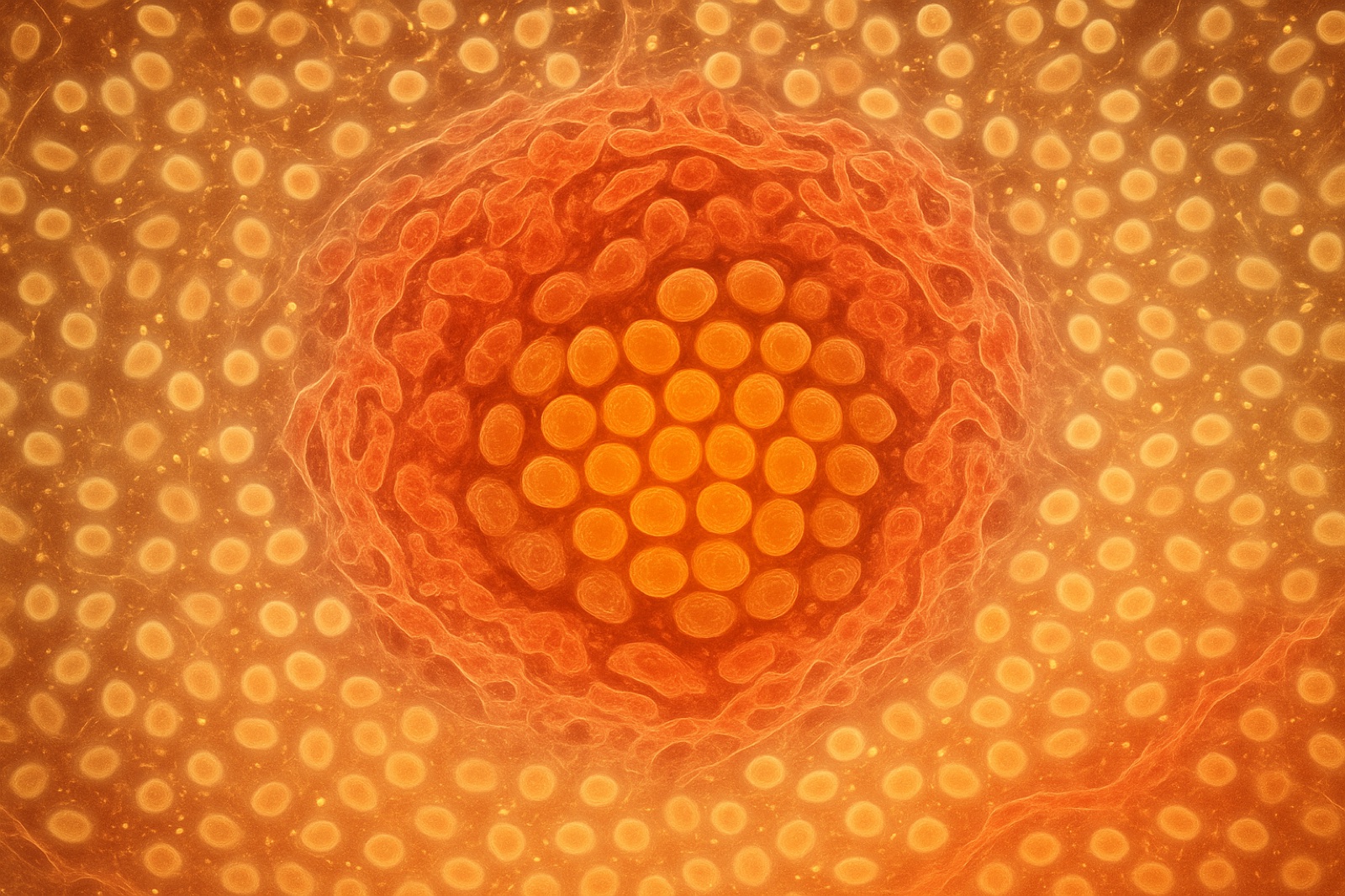
Dormant cells, it turns out, are not scattered at random. They gather. And where they gather, they are consistently ringed by two other kinds of cell: a type of immune cell called a CXCL10-positive macrophage, and connective-tissue cells known as myofibroblastic cancer-associated fibroblasts.
Dr Maria Secrier, the UCL computational biologist who co-led the work, described what that looks like: “The cancer cells are really encapsulated within these areas of macrophages and fibroblasts that we think act as shields.”
Shields. Cells whose ordinary daily job includes defending the body appear to be forming a pocket around the very cells a treatment most needs to reach.
The busy, fast-dividing regions of the same tumor looked completely different — different immune signatures, different signalling, and, the researchers predict, different responses to different drugs. “Different parts of the tumor will likely respond to different drugs,” Secrier said.
That is a genuine shift in how to picture the problem. A tumor is not one thing being treated. It is several neighbourhoods, and a drug that works well on one street may never really arrive on the next.
The Detail Almost Nobody Repeated
Sitting inside the study is a finding that runs against how most of us imagine cancer works.
We tend to assume the most dangerous cells must be the most damaged ones — the most mutated, the most genetically scrambled. These dormant cells were the opposite. They carried a lower burden of copy number alterations, meaning fewer of the large-scale genetic scramblings that usually mark aggressive disease. Genetically, they looked calmer than the cells around them.
What made them persistent was not extra damage. It was a change in behaviour — the cell’s stress-response machinery reprogrammed, and more flexibility to shift between cell identities. They last by adapting and waiting, not by mutating harder.
Which is worth sitting with for a second. The cells that outlast the treatment are not the loudest ones in the room.
What This Does and Doesn’t Mean
This was a mapping study. The team analysed existing tumor data. Nobody was treated with anything, and no individual patient outcome was measured or predicted. Two honest limits sit right at the centre of it:
- The predictions still have to be tested. The researchers found raised activity in something called the complement pathway inside these dormant pockets, which makes it an interesting thing to aim at. But it is a target on paper. It is not a treatment, and it is not on offer anywhere.
- Nobody knows which came first. It is not clear whether the shield cells cause the cancer cells to go dormant, or whether they simply gather around cells that had already gone quiet. Cause and effect are genuinely unresolved here.
And one thing needs saying with no hedging at all, because words like “hiding” can land badly on the people this actually concerns: none of this is about anything a patient did. Nobody shelters their own disease. This is cell biology happening at a scale no human being has any say over, in a body that was doing its best the whole time.
It is also a good reminder to read the fine print on any single study before it changes how you feel — the same care that a large study can look conclusive and still not say what the headline says.
What the map does explain is something survivors already knew without needing a diagram: why “cured” was never quite the word anyone reached for. Doctors say “no evidence of disease.” Now there is a picture of why that phrasing is careful rather than cold.
Living Inside a Question That Stays Open
Which leaves the harder part, and it is not a medical question. How do you live well inside something that will not resolve?
Most of the usual advice quietly assumes the uncertainty is temporary. Wait it out, stay positive, it will pass. But some uncertainty does not pass. It just becomes the shape of the room you live in. If you have noticed your own mind running the same loops at two in the morning, it can help to see plainly what that is doing to you — this free assessment takes a couple of minutes and does not ask for anything.
There is an old idea about peace that has always struck me as strangely honest, and it is not the one most people expect. It does not describe the peace God gives as certainty, or as the good news finally arriving. It describes it as something posted around a person — a guard set over the heart and the mind, standing there while the question stays wide open. Not the removal of the thing being waited on. Company inside the wait.
That is a strange picture until the day you need it. Then it is the only one that fits, because the alternative on offer — that peace can only show up once the answer does — leaves an awful lot of people holding nothing at all for years at a time.
The Week Before the Scan
Scans will still come. The week before one will still have its own weather. Nothing in a spatial map of tumor tissue changes that, and it would be dishonest to pretend otherwise.
But there is something quietly steadying in knowing the uncertainty is real and structural rather than personal. It lives in the biology, not in some failure of your optimism. You are not being irrational. You are responding accurately to something that is genuinely unfinished. Fear that has a real object is a different animal from fear with no floor under it — which is worth knowing about fear generally.
And unfinished is not the same as unreachable. Somebody has now drawn the map of where these cells sit, and drawing the map is always the part that has to happen first. Someone charts it. Then, later, someone gets there.
In the meantime, the quiet after treatment is not empty. It only feels that way. There is more going on in it than anyone can see — including, it turns out, under the microscope.
Questions People Ask
What are dormant breast cancer cells?
Dormant breast cancer cells are tumor cells that have stopped dividing and entered a resting state biologists call G0, also described as quiescent. They are still alive and still cancer cells, but because they are not actively dividing they do not behave the way growing tumor cells do. Researchers believe these resting cells are one reason some breast cancers return after treatment appears successful.
Why does chemotherapy struggle to kill dormant cancer cells?
Most chemotherapy drugs work by attacking cells while they divide, which is what makes them effective against fast-growing tumors and also why they damage healthy fast-dividing tissue. Cancer cells in a dormant, non-dividing state are not doing the thing those drugs target, so they are far less exposed to the treatment and can survive it.
What did the 2026 Genome Medicine study find about dormant breast cancer cells?
A study titled “Spatial ecology of breast cancer reveals co-evolution of proliferative and dormant niches”, published in Genome Medicine on 9 July 2026 by researchers at the MRC Laboratory of Medical Sciences, Imperial College London and the UCL Genetics Institute, used single-cell and spatial profiling to map where dormant cells sit inside breast tumors. It found them clustered in distinct niches with raised complement pathway activity, closely surrounded by CXCL10-positive macrophages and myofibroblastic cancer-associated fibroblasts, which the researchers suggest may shield them from treatment.
Are dormant cancer cells more mutated than actively growing ones?
Not according to this research. The dormant, persister-like cells identified in the Genome Medicine study carried a lower burden of copy number alterations than the actively proliferating cells around them, meaning fewer large-scale genetic changes. What set them apart was reprogrammed stress-response activity and greater flexibility to shift between cell states, rather than heavier genetic damage.
Does this study mean a breast cancer will come back?
No. The study is a map of tumor tissue architecture, not a prediction about any individual. It analysed existing tumor data and did not measure or forecast patient outcomes, and the researchers state clearly that their findings still need to be tested experimentally before they could change any treatment. It explains a mechanism that may contribute to relapse in some cases; it says nothing about what will happen to any particular person.
What Do You Think?
Doctors almost never say “cured.” They say “no evidence of disease.” Do you think that careful, technically honest wording helps people — or does it make the waiting harder to carry? There is no right answer here, and both sides of it are reasonable. Leave a comment and tell us how you would want it said to you.
Share This
- Turns out the cancer cells that survive treatment aren’t the most mutated ones. They’re the calmest ones — the ones that stopped moving and waited. Nobody talks about that part. https://bgodinspired.com/index.php/health-and-wellness/dormant-breast-cancer-cells-where-they-hide/
- Scientists just mapped where dormant breast cancer cells hide inside a tumor, and they’re ringed by immune cells that seem to be acting as shields. Also: nobody knows yet whether the shields caused the hiding, or just showed up afterwards. https://bgodinspired.com/index.php/health-and-wellness/dormant-breast-cancer-cells-where-they-hide/
- “Cured” was never the word. Doctors say “no evidence of disease” — and there’s now a picture of exactly why that wording is careful rather than cold. Worth a read if you’ve ever counted down to a scan. https://bgodinspired.com/index.php/health-and-wellness/dormant-breast-cancer-cells-where-they-hide/