 0
0
 0
0
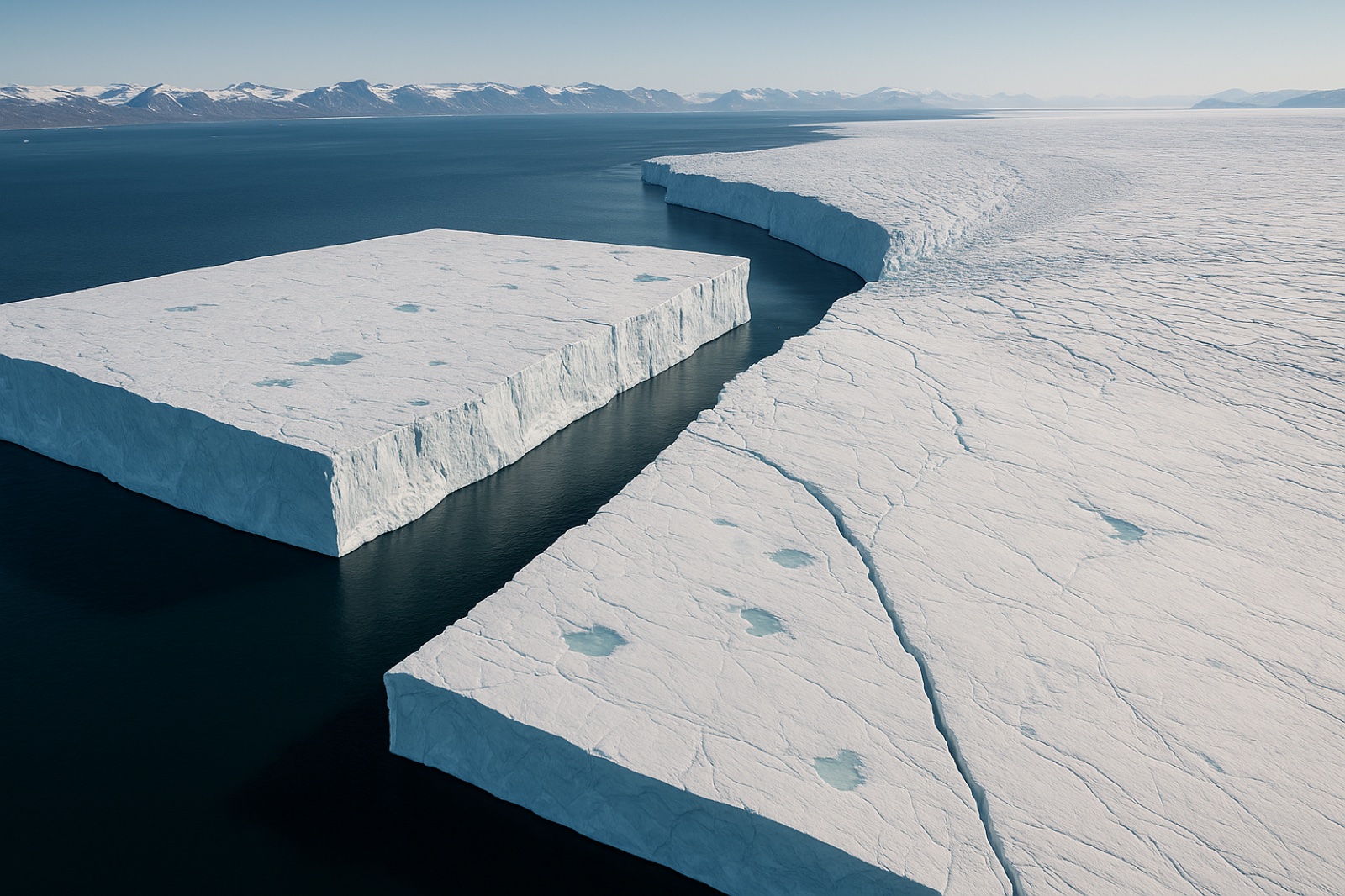
On the evening of 4 August 2026, a slab of ice roughly the size of Manhattan stopped being part of Greenland.
It did not sink. It did not shatter. It simply drifted away from the glacier it had been attached to for a very long time, and became its own thing: a Greenland ice island, floating free in the Arctic Ocean.
The photographs are striking. A clean dark line of water where, a day earlier, there had been ice.
But the most interesting part of this story is not the break. It is what the people watching said afterward.
They said they had been expecting it for years.
What Actually Broke Off Petermann Glacier
Petermann Glacier sits in northwest Greenland. Like a few of the biggest glaciers left in the Arctic, it does not simply stop at the coast. It pushes out over the water and keeps going, forming what scientists call a floating ice tongue — a long shelf of ice that is still attached to the glacier but is already sitting on the sea rather than on land.
On 4 August, a piece of that tongue came off.
- Size: 76.4 square kilometres (about 29.5 square miles) — the comparison the research team reached for was Manhattan Island.
- Thickness: up to 150 metres (roughly 490 feet).
- Time of separation: confirmed at 20:00 UTC on 4 August.
- How anyone knew: radar images from the European Space Agency’s Sentinel-1 satellites.
It was Petermann’s largest loss of floating ice since 2012, and the biggest calving event anywhere in the Arctic since 2020. The break was identified by Adam Garbo, a doctoral student in glaciology at the University of Ottawa, working with researchers from the University of Stirling, Lancaster University, the University of Leeds, and Environment and Climate Change Canada.
That is the news. Here is the part underneath it.
“We’ve Anticipated This Break for Years”
When the ice island was confirmed, Garbo described Petermann as one of Greenland’s largest remaining ice tongues, and added: “We’ve anticipated this break for years, and seeing it finally happen is remarkable.”
Read that again slowly, because it quietly rearranges the whole story.
The team had been watching this stretch of ice since 2019. And in the satellite pass taken on 3 August — the day before — the radar already showed pronounced deterioration running down the centre line of the tongue. The crack was doing its work in plain sight.
So the thing that happened on 4 August was not the breaking. The breaking had been happening for years.
What happened on 4 August was the separation — the moment the last bit of connected ice let go and the change finally became visible from space.
That is a small distinction, and it matters more than almost anything else in this story.
Why an Ice Island Is Not Just a Big Iceberg
The term “ice island” is not a flourish. It describes a specific kind of object: a broad, flat, tabular block calved from a floating ice shelf or tongue, rather than the jagged chunk most people picture when they hear “iceberg.”
Dr Anna Crawford of the University of Stirling noted that Arctic ice islands are far rarer than their Antarctic equivalents. Dr Abigail Dalton of the Canadian Ice Service described them plainly: thick blocks of ice that can drift for years.
Years. That is the timescale here at both ends. Years for the crack to open. Years for the piece to wander.
One point of precision that is worth getting right, because a lot of quick coverage skips it: this ice was already floating before it broke. Ice that is already afloat has already pushed aside its own weight in seawater — that part of the physics has not changed since Archimedes worked it out. A floating tongue splitting apart is a different event from land ice sliding into the ocean, and the two should not be blurred together. What researchers are watching closely is the tongue itself, and how much of it is left.
The Next Two Breaks Already Have Numbers
This is the detail that stayed with me.
The team has already identified two more sections of the ice tongue expected to detach: one of roughly 94 square kilometres, and one of roughly 84 square kilometres. Together with what has already gone, that would remove somewhere around 22 percent of the remaining tongue.
They are not guessing that something might eventually happen somewhere. They can point at the ice and say: that piece, and that piece.
The fracture lines are visible now. The separation is just a matter of when.
There is something almost uncomfortable about knowing that. A thing can be measured, mapped, named, and given a size in square kilometres, and still be sitting there looking perfectly solid from a distance.
Nothing Large Ever Actually Breaks Suddenly
You already know where this goes, because you have watched it happen to a person.
Someone quits with no warning. Someone walks out of a marriage on an ordinary Thursday. Someone who has held everything together for a decade simply stops, and everyone around them says the same word: sudden.
It is almost never sudden. It is the separation that is sudden. The fracture ran for years, down the centre line, in plain sight of anyone who happened to be looking with the right instrument.
We even have new language for the earlier stage now. Quiet cracking is the term that has emerged for people who are coming apart internally while still performing perfectly on the outside — still hitting deadlines, still answering messages, still showing up. From the coastline, the ice looks intact.
And here is the odd thing about glaciers: the crack is not a failure of the ice. It is what happens when something has been carrying weight, and moving, and holding a shape it was never built to hold forever.
There is a very old teaching about two houses that looked identical from the road. Same shape, same size, same everything a passer-by could see. The difference between them was underground, in the part nobody could photograph, and it stayed invisible right up until the weather arrived. The point of the story was never that one builder was clever. It was that the part you cannot see is the part that decides. That is roughly the oldest observation anyone has ever made about people, and it is one of the few places where the language of God and the language of a radar satellite are describing the same thing: the foundation is the story, and the collapse is only the announcement.
Which means the useful question is almost never why did that happen so suddenly. It is: what is already cracking that nobody has looked at yet?
What to Look For This Week
None of this requires money, a specialist, or spare time. It mostly requires being willing to look.
- Find your centre line. Glaciers do not crack randomly — they crack where the stress concentrates. For most people it is one specific thing: the commute, the one relationship, the money, the sleep. Name it out loud once. Naming is not fixing, but nothing gets fixed before it gets named.
- Notice what you have stopped doing. The earliest sign is usually subtraction, not collapse. You stopped cooking. You stopped calling that friend. You stopped reading. Those are the first thin lines.
- Check the timescale, not the day. “I’m fine today” is not the same measurement as “I have been fine for a year.” Ask the longer question.
- Ask someone who watches you. The break was found because somebody had been looking at the same stretch of ice since 2019. Most of us do not have a satellite. We do have people who have known us a long time, and they usually know.
- Rest before, not after. Rest taken after the separation is called recovery, and it takes far longer.
If you want a structured version of that first step, we built a free Am I Burned Out at Work? assessment that walks through the usual stress points and tells you honestly where you are sitting. It takes a couple of minutes and asks for nothing.
The Ice Is Still There
It is worth saying plainly that this is not the end of Petermann Glacier. The tongue is smaller. Most of it is still there. The satellites will keep passing overhead every few days, and the researchers will keep watching, and at some point the next piece will let go and someone will write that it happened suddenly.
Meanwhile the ice island itself is out there now, drifting, thick enough to survive for years.
It is a strange kind of comfort, actually. The crack ran for years before anyone could say the word “break.” Which also means there were years in which somebody was watching, and measuring, and knew exactly where the weak line was.
That is usually true of people too. The line is visible before the break. Someone just has to look.
If you are curious how the same process plays out on an even larger scale, scientists recently pinned down the exact moment right before a continent splits in two — and borrowed the word for it from childbirth.
Questions People Are Asking
What is the Greenland ice island that broke off in August 2026?
On 4 August 2026, a tabular ice island measuring 76.4 square kilometres (about 29.5 square miles) and up to 150 metres thick detached from the floating ice tongue of Petermann Glacier in northwest Greenland. Separation was confirmed at 20:00 UTC using radar imagery from the European Space Agency’s Sentinel-1 satellites. It was Petermann’s largest loss of floating ice since 2012 and the largest Arctic calving event since 2020.
What is the difference between an ice island and an iceberg?
An ice island is a broad, flat, tabular block of ice that calves from a floating ice shelf or glacier tongue. A typical iceberg is more irregular in shape. Ice islands are thick — the Petermann one reaches about 150 metres — and can drift for years before breaking up. Arctic ice islands are considerably rarer than their Antarctic counterparts, because far fewer large floating ice tongues remain in the Arctic.
Did scientists know the Petermann Glacier break was coming?
Yes. Researchers had been monitoring this section of Petermann Glacier since 2019, and radar imagery from 3 August 2026 — the day before separation — already showed pronounced deterioration along the centre line of the ice tongue. Adam Garbo of the University of Ottawa, who identified the break, said the team had anticipated it for years. Two further sections, of roughly 94 and 84 square kilometres, are expected to detach in future.
Where is Petermann Glacier?
Petermann Glacier is in northwest Greenland, draining into the Nares Strait between Greenland and Canada’s Ellesmere Island. It is notable for its floating ice tongue — a long shelf of glacial ice extending out over the ocean rather than ending at the coastline. It is one of the largest remaining ice tongues in Greenland.
Does a floating ice tongue breaking off raise sea level?
Ice that is already floating has already displaced its own weight in seawater, so a floating tongue breaking apart is not the same event as land-based ice entering the ocean. That distinction is basic physics and is often lost in short news coverage. What researchers monitor is the condition and remaining extent of the ice tongue itself over time.
What Do You Think?
Here is the question worth arguing about: when someone we know falls apart “out of nowhere,” is that really because the signs were invisible — or because nobody was looking at the right stretch of ice? Do we actually miss the cracks, or do we notice them and quietly hope they hold? Tell us where you land in the comments.
Share This
- A slab of ice the size of Manhattan just broke off Greenland. The scientists watching it said they’d been expecting it for years. Nothing big ever actually breaks suddenly — the separation is just the part you can see. https://bgodinspired.com/index.php/nature-and-creation/greenland-ice-island-petermann-glacier/
- A 76 km² ice island just left Greenland. The crack had been running down the middle of that glacier for years, in plain sight. https://bgodinspired.com/index.php/nature-and-creation/greenland-ice-island-petermann-glacier/
- “We’ve anticipated this break for years.” That’s what a glaciologist said when a Manhattan-sized ice island finally split off Greenland — and honestly it’s the most human sentence I’ve read all week. https://bgodinspired.com/index.php/nature-and-creation/greenland-ice-island-petermann-glacier/
Reporting drawn from the University of Ottawa-led research team’s announcement and European Space Agency Sentinel-1 imagery. Further detail: phys.org.